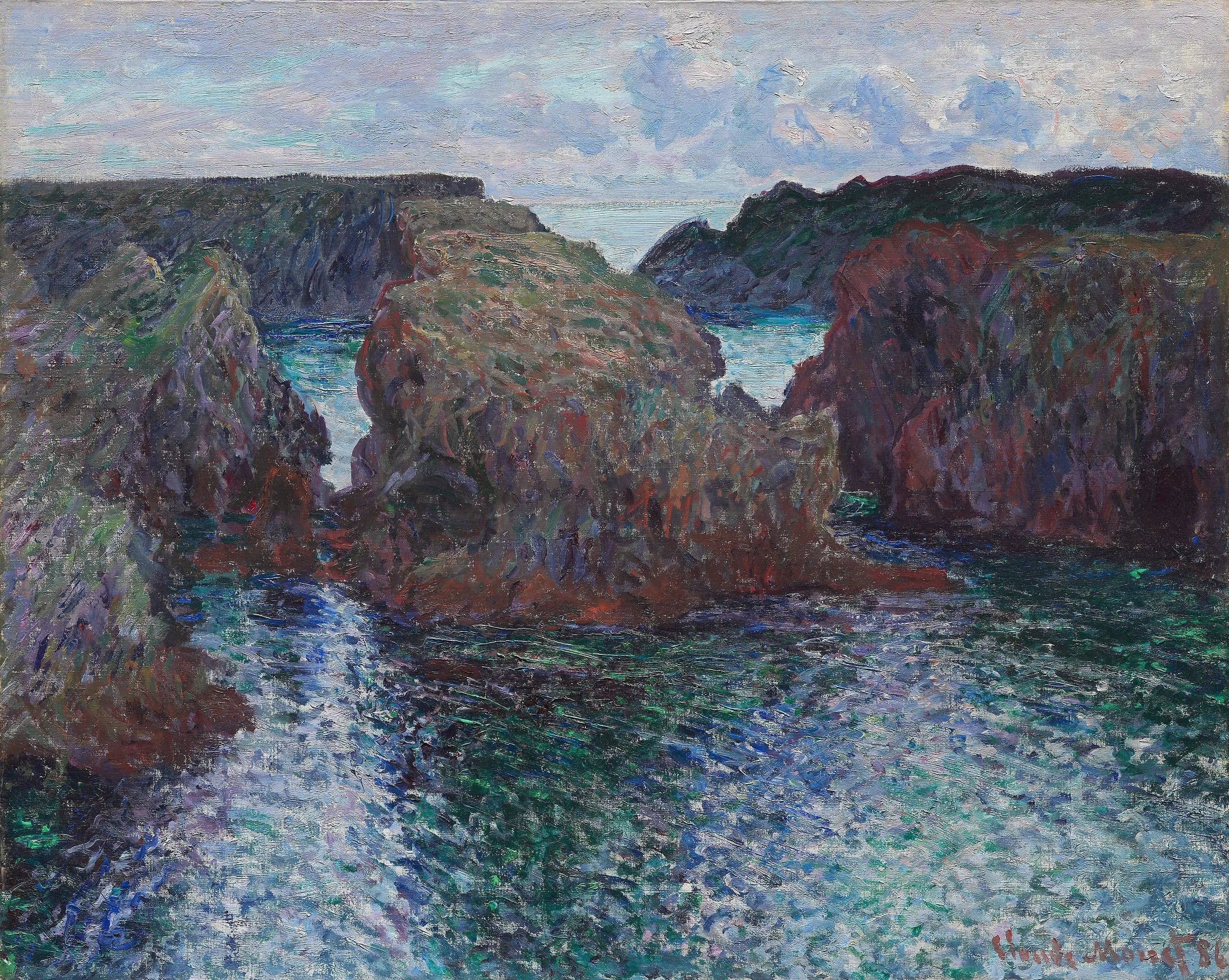
Rocks at Port-Goulphar, Belle-Île
- Original dimensions
- 81.8 x 66 cm
- Museum
- Art Institute of Chicago
- Year
- 1886
Scene depicted
In the painting “Rocks at Port-Goulphar, Belle-Île,” Monet offers us a striking composition of rocky landscapes, embraced by the shimmering reflections of the sky and waters. The painting depicts a scene where the horizon merges with the tumult of the sea, filled with delicate shades that illustrate the magical and changing atmosphere of the island.
Historical context
Year: 1886 |BRK| Museum: Art Institute of Chicago |BRK| Dimensions: 81.8 x 66 cm
Place in the artist's career
This painting , deeply rooted in the Impressionist movement, marks a turning point in Monet's career. It sits between his earlier works, such as “ Impression, Sunrise ” and his later explorations of water lilies . Each canvas denotes a distinct evolution, both technically and emotionally, reflecting his relentless quest to capture the ephemeral.
Anecdote
Monet once stated: “Light is the very essence of color.” It is in the heart of coastal landscapes that the artist finds inspiration, wandering among the rocks bathed by the thick waves of the Atlantic. This painting is the result of a summer morning, where the gentle whisper of the waves and the freshness of the sea air nourish his creative soul. The palpable emotion of this moment shines through in the evocative strength of the canvas .