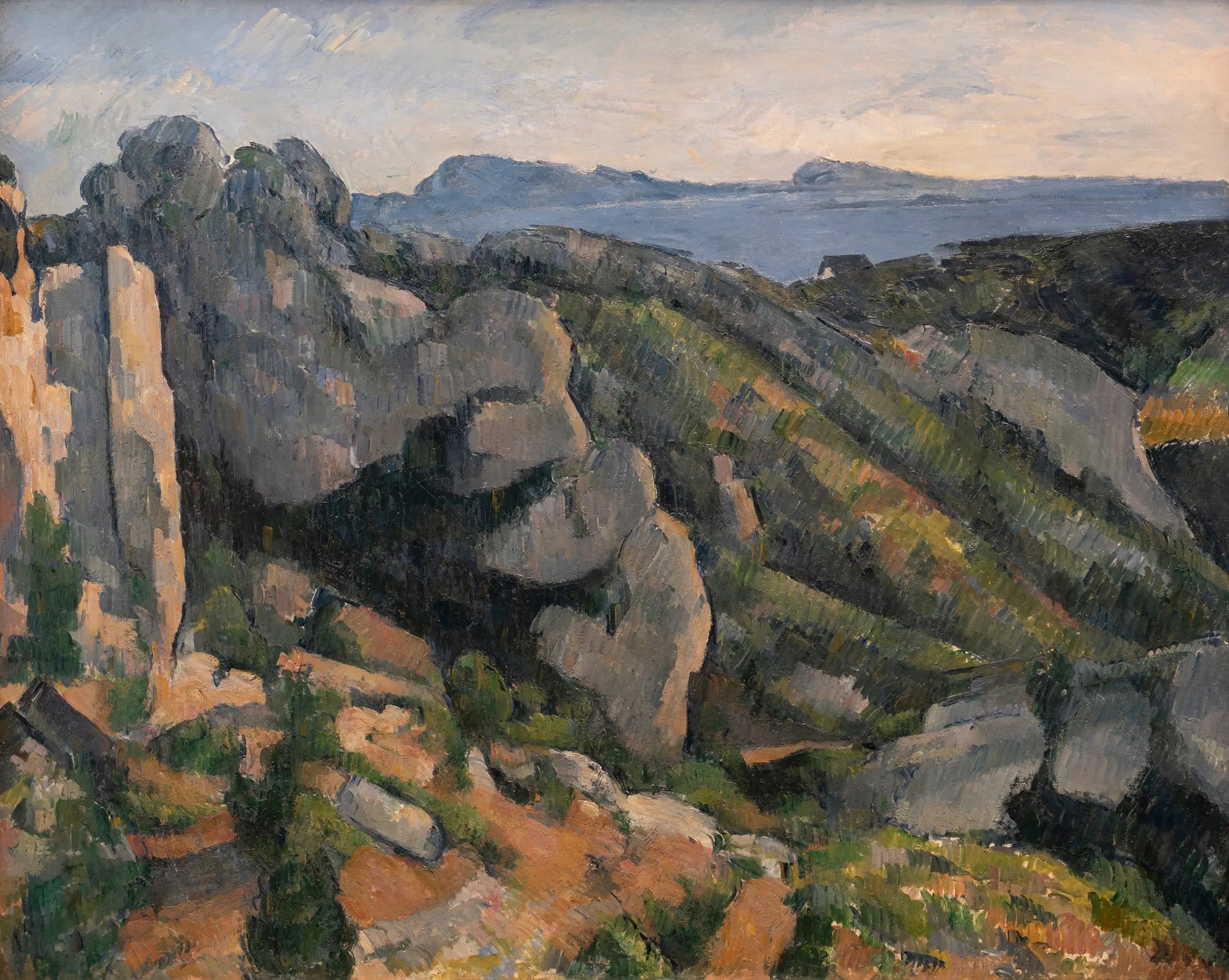
Rocks at L'Estaque
- Original dimensions
- 91 x 73 cm
- Museum
- São Paulo Museum of Art
- Year
- 1879
Scene depicted
In this painting, Cézanne invites us to discover a natural scene where the rocks, bathed in light, converse with the deep blue of the sea. The angular shapes of the rocks contrast with the softness of the waves, creating a composition where nature and art merge. The gaze gets lost in this harmony of colors and textures, each brushstroke testifying to an unparalleled passion for the raw and wild beauty of l'Estaque.
Historical context
Created in 1879, in the charming village of l'Estaque, near Marseille, this painting is emblematic of the Impressionist movement, before its artist, Paul Cézanne , cracked the boundaries of this emerging style. The painting is now under the benevolence of the São Paulo Museum of Art , captivating art admirers through the ages. This canvas , with its dimensions of 91 x 73 cm, still resonates with echoes of the time when light and color became the protagonists of an artistic revolution.
Place in the artist's career
Rocks at l'Estaque represents a crucial step in the career of Paul Cézanne , reflecting both stylistic maturity and an identity quest. Alongside other major paintings such as “The Montagne Sainte-Victoire” and “The Card Players,” this masterpiece shows the evolution of his exploration of volumes and colors, paving the way for Cubism and the artistic revolutions of the 20th century.
Anecdote
“I want to paint the light, the warmth of the Mediterranean,” Cézanne is said to have expressed during his morning walks by the sea. It is exactly this moment, mingled with the serenity of the sunlit rocks, that imbues the painting with this evocative force. Through the retreat of the hills, inspiration transforms into a masterpiece , revealing the very soul of the Mediterranean landscape.