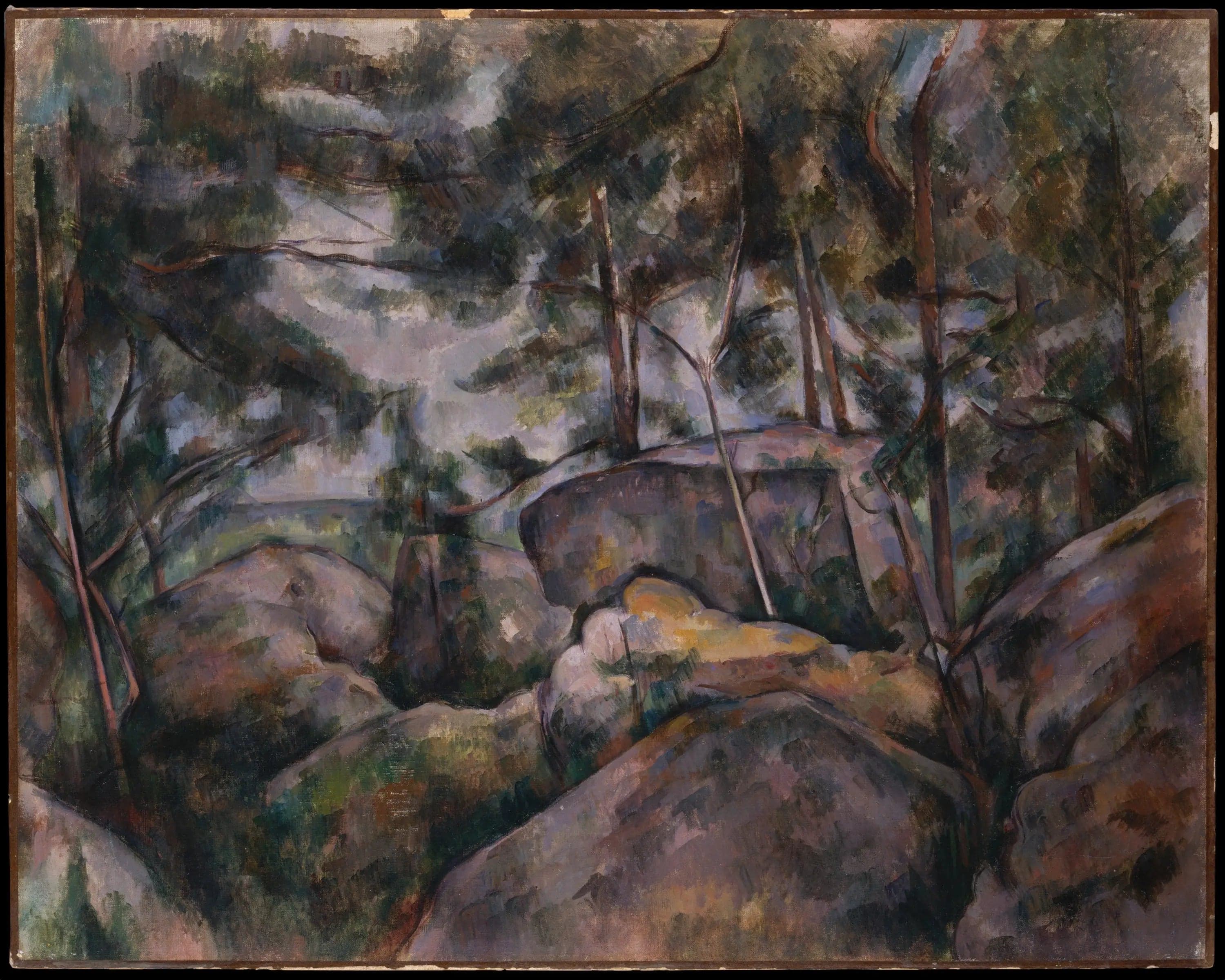
Rocks at Fontainebleau
- Original dimensions
- 92.4 x 73.3 cm
- Museum
- Metropolitan Museum of Art
- Year
- 1893
Scene depicted
The painting “Rochers à Fontainebleau” illustrates a powerful composition where the rock formations rise majestically, capturing the essence of the surrounding landscape. Through this painting, Cézanne seeks to convey the harmony between rock and greenery, a reflection of his admiration for the grandeur of nature.
Historical context
Created in 1893, this painting signed Paul Cézanne emerges from a time when the Impressionist movement was in full swing. Located in Fontainebleau, this canvas reflects the artist's fascination with nature, in a region rich in inspiring landscapes that have captivated many artists. Currently on display at the Metropolitan Museum of Art , this painting resonates with the fertile artistic climate of the late 19th century.
Place in the artist's career
“Rochers à Fontainebleau” stands at a crucial crossroads in Cézanne's career. This masterpiece marks his finely-tuned exploration of forms, akin to other iconic pieces such as “Mont Sainte-Victoire” and “La Maison de Château Noir,” where the artist demonstrates an evolution towards a more analytical structure in his work.
Anecdote
“Nature cannot be grasped at once; it must be studied, revisited, and patience is required.” This quote illustrates Cézanne's artistic journey, often inspired by morning walks in the Fontainebleau forest, where every shadow and ray of light became a delicate melody, nourishing the soul of his painting .