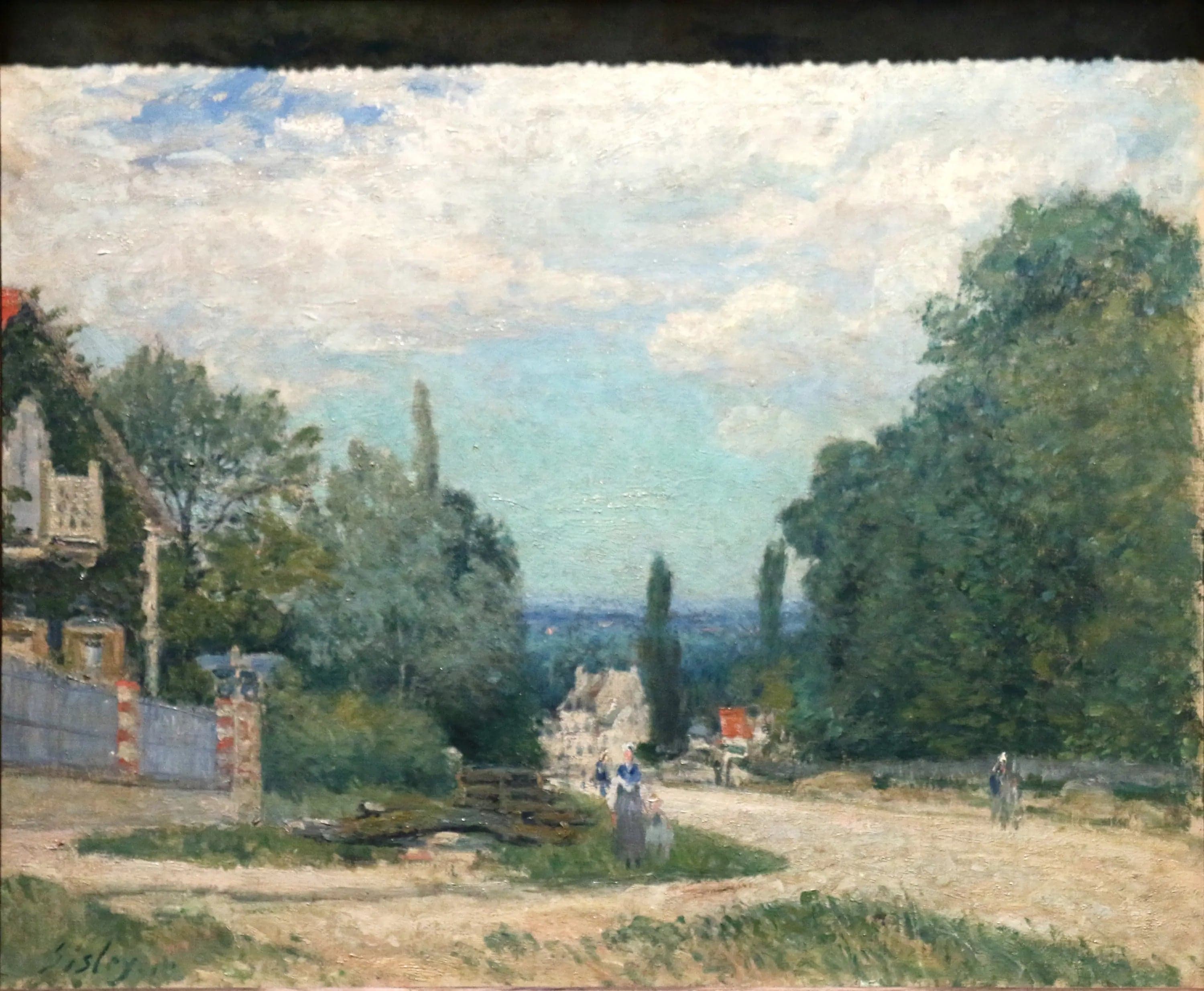
Road to Louveciennes
- Original dimensions
- 56.5 x 46.5 cm
- Museum
- royal museums of Fine Arts of Belgium
- Year
- 1874
Scene depicted
The canvas “Route de Louveciennes - Alfred Sisley ” transports us to the edge of a path, where the serenity of a rural landscape is highlighted. The lush canopies and luminous reflections on the ground create a peaceful harmony, irresistibly alluring. Sisley immortalizes this fleeting moment of dawn, offering a glimpse into the simple yet profound daily life of the inhabitants of this region. The anxiety of the modern world seems suspended, inviting the gaze to immerse itself in this painting.
Historical context
Created in 1874, this painting emblematic of the master impressionist Alfred Sisley immerses the viewer in the heart of the soothing landscapes of Louveciennes, in the Paris region. In a setting where nature and light intertwine, this pictorial work belongs to the impressionist movement, characterized by the expression of visual sensations and an evanescent capture of the moment. Today, this canvas is found within the royal museums of Fine Arts of Belgium , testifying to its importance in the history of art.
Place in the artist's career
This painting is situated in a key period of Alfred Sisley 's career, illustrating his full commitment to the impressionist movement. At that time, Sisley sought to capture the light and movement of nature. Other notable works, such as Monet's “Impression, Sunrise” or Pissarro's “The Charing Cross Bridge,” show an evolution towards an approach to light and atmospheres that resonate in his Route de Louveciennes .
Anecdote
“The morning light dances on the leaves and whispers promises,” Sisley might have declared while contemplating the nature that inspired him. This sweet escape, amidst a spring morning, allowed him to weave a palpable emotion into his painting . It is in the silence of his walks that the evocative power of the Route de Louveciennes was born, at the crossroads of his creative mind.