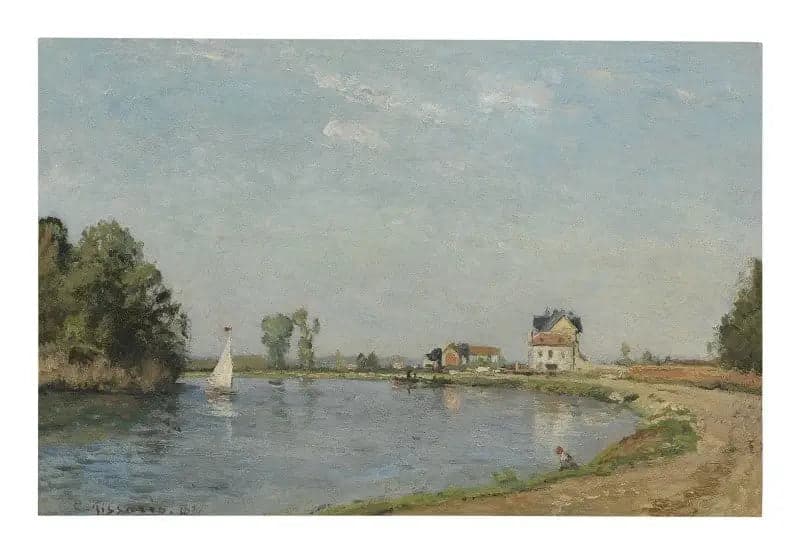
Riverbanks
- Original dimensions
- 40.5 x 27 cm
- Museum
- Not specified
- Year
- 1871
Scene depicted
In this pictorial work, Camille Pissarro captures the very essence of riverside tranquility. The canvas depicts an idyllic landscape where the sparkling water meets the pastel sky, and where majestic trees gracefully bend, offering a sense of serenity. Each brushstroke seems to whisper a story, revealing the secrets of the flow of a peaceful life and its splendors.
Historical context
The painting "Riverbanks" was created in 1871, in the heart of the beautiful French countryside, at a time when realism and impressionism were beginning to redefine art. This iconic painting, born from a rich historical context, bears witness to the birth of an artistic era where nature is celebrated. Today, it remains a centerpiece in the cultural landscape, although its precise location in a museum is yet to be determined.
Place in the artist's career
The painting "Riverbanks" represents a turning point in Pissarro's career, marking his transition to more free and luminous compositions. Compared to "La Hoëgne" and "Boulevard Montmartre, spring," this painting shows a brilliant technical evolution towards a more impressionist approach, rich in colors and light.
Anecdote
"Nature has so much to offer us, we just need to open our eyes and let our hearts express themselves." These seemingly simple words are a key to understanding the genesis of this masterpiece . Imagine Camille, bent over his canvas by the riverbank, one spring morning. The golden light caresses the waters while the song of the birds announces the awakening of nature. This striking scene has imbued his soul and transformed his experience into painting .