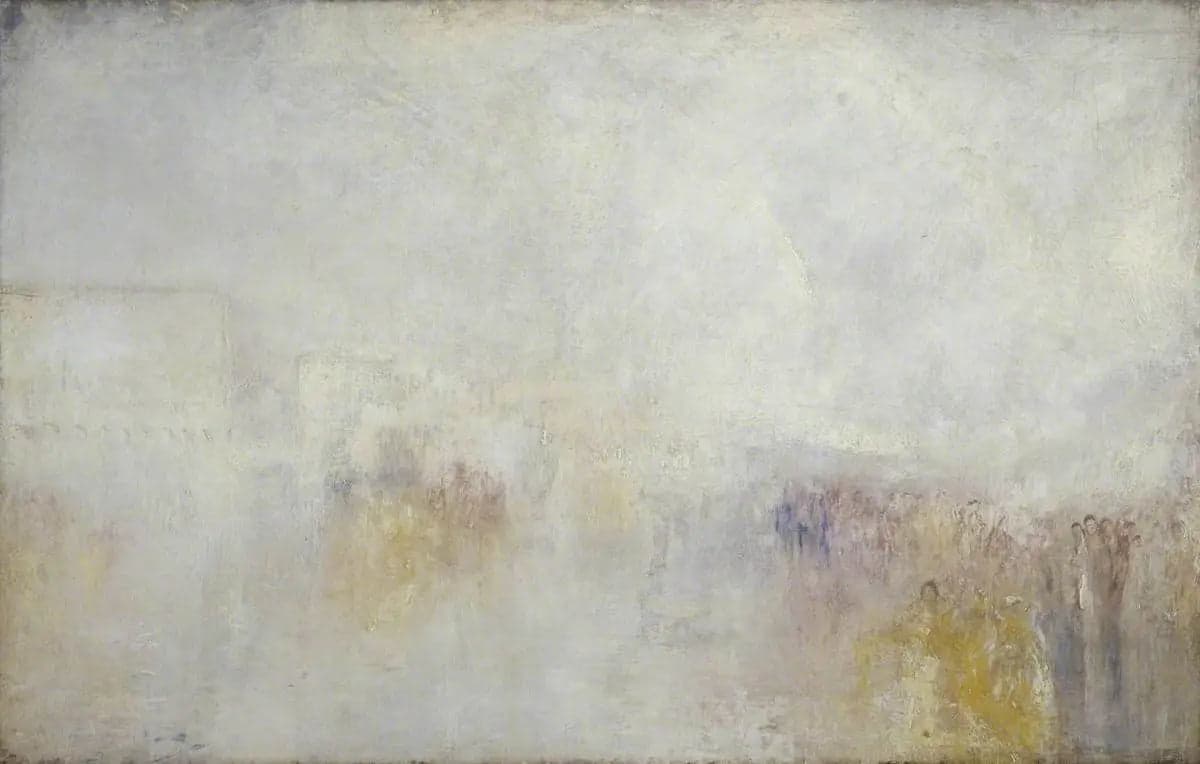
Riva degli Schiavone, Venice: Water Fête
- Original dimensions
- 72.4 x 113 cm
- Museum
- Tate
- Year
- 1845
Scene depicted
This painting explores the enchanting beauty of a fête on the water, magnifying the dance of gondolas under a sky that one can guess is blazing. The characters, perhaps intoxicated by the Venetian charm, seem to float in a communion between the joy of men and the majesty of the elements. Turner, with unmatched mastery, immerses us in this pastel celebration where each reflection on the water becomes a vibrant visual melody.
Historical context
Created in 1845, this iconic work of the English master, Joseph Mallord William Turner , finds its roots in the splendor of Venice, a city that embodies the artistic excess of the romantic movement. Through his painting, Turner manages to capture the very essence of the water fête, a symbol of an era where architecture and nature intertwined with palpable elegance. Today, this painting is carefully preserved at the Tate museum, where it continues to amaze its visitors and testifies to the creative genius of the 19th century.
Place in the artist's career
Riva degli Schiavone, Venice: Water Fête sits at the crossroads of Turner’s stylistic pathways, a high point in his quest for light and color. Close to other flagship pieces like “The Grand Canal, Venice” and “Rain, Steam and Speed,” this painting testifies to his evolution from a technical artist to a complete master of romanticism , moving from an almost photographic precision to a poetic abstraction.
Anecdote
“The light reveals itself like a breath of life on the water,” Turner might have exclaimed while contemplating the shimmering expanse of the canal. Inspired by the festivities adorning the Venetian lagoon, he dipped his brush into the dazzling light of a fresh morning, capturing laughter and light music in every brushstroke. This painting then becomes the narrative of a fleeting moment, frozen for eternity.