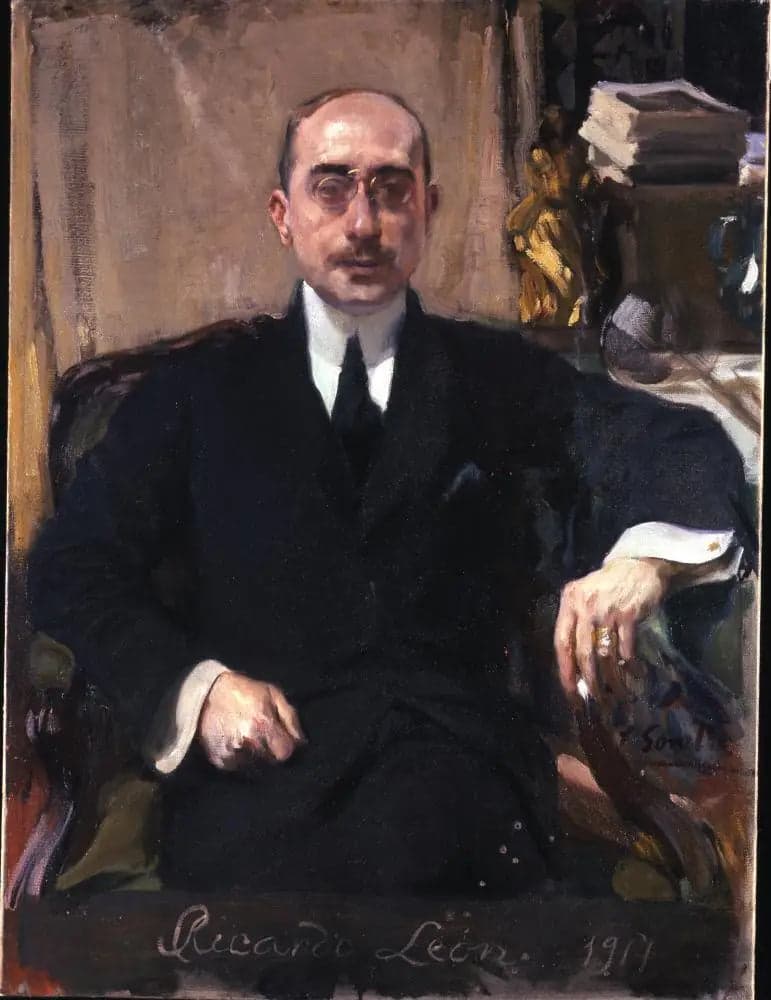
Ricardo de León y Román
- Original dimensions
- 83 x 110.5 cm
- Museum
- The Hispanic Society of America
- Year
- 1917
Scene depicted
The scene depicted in Ricardo de Léon y Román illustrates a moment of conviviality and introspection. The protagonist, immersed in his thoughts, reflects an atmosphere of tranquility and wisdom. Each brushstroke invites the viewer to feel the emotions of this precious moment, creating a deep connection between art and the observer.
Historical context
It was in 1917, in the heart of New York, that Joaquín Sorolla unveiled his iconic canvas, Ricardo de Léon y Román . At that time, the artist stood out for his commitment to the Impressionist movement, capturing the light and delicate nuances of everyday life. This painting is now located at the Hispanic Society of America, where it testifies to the cultural richness of Spain through the eyes of a master. With imposing dimensions of 83 x 110.5 cm, this canvas embodies many of the visual ideals of its time.
Place in the artist's career
Ricardo de Léon y Román fits into Sorolla's mature period, where he perfected his approach to the play of light and the depth of shadows. It is a highlight of his career, where he successfully combines introspection and expression. Compared to other works like The Beach of Valencia and The Ballerinas , this painting demonstrates his technical evolution, marking a turning point in his distinctive style.
Anecdote
“For me, each painting is a window to the soul,” said Sorolla. This masterpiece was born from a bright morning, as he observed a young man in a sunny café in Madrid. This fleeting moment transcended the ordinary to imbue the painting with life and emotion, creating a vibrant pictorial work.