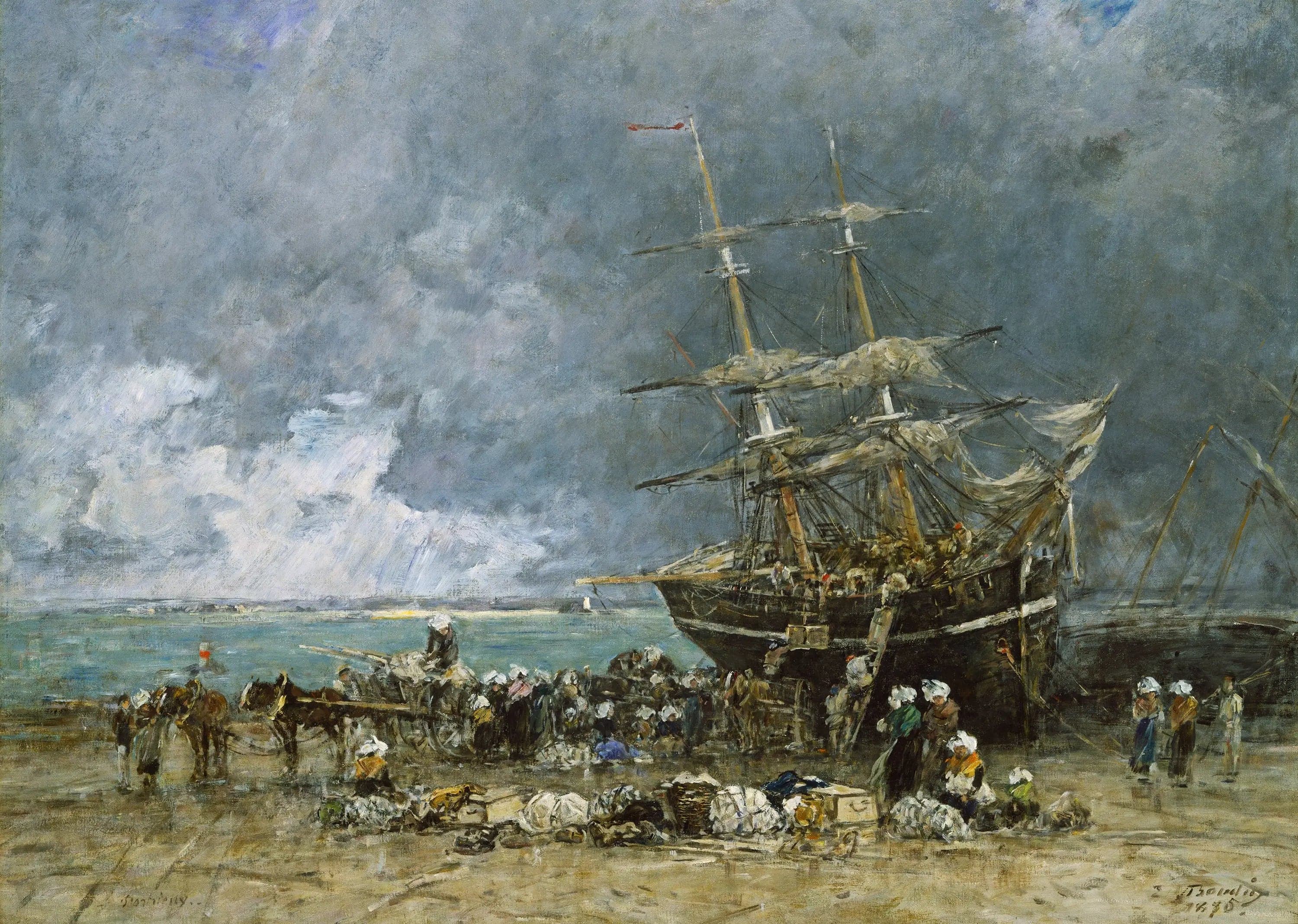
Return of the Newfoundland
- Original dimensions
- 100.7 x 73.5 cm
- Museum
- National Gallery of Art
- Year
- 1875
Scene depicted
The painting "Return of the Newfoundland" illustrates a vibrant scene of coastal life, as fishermen return to port after a day full of emotions. The white sails of the boats stand out against the blue of the sky, reflecting maritime labor, while the horizon seems to embrace the tumultuous ocean. This composition skillfully merges exploration and tranquility, reflecting the maritime daily life of the 19th century.
Historical context
Created in 1875, in the beautiful city of Deauville, this painting is at the heart of the Impressionist movement. At a time when light and nature are celebrated, the canvas "Return of the Newfoundland" reveals all the virtuosity of Eugène Boudin . Currently exhibited at the National Gallery of Art , this canvas measures 100.7 x 73.5 cm, reflecting a rich past of colors and shades.
Place in the artist's career
"Return of the Newfoundland" represents a turning point in the career of Eugène Boudin , illustrating his research between landscapes and seascapes. In parallel, works like "Trouville Beach" and "The Port of Honfleur" show the stylistic evolution of the artist, oscillating between realism and impressionism . This painting is a colorful celebration of his pictorial approach, rooted in the 19th century.
Anecdote
“Every brushstroke is an ode to the morning humidity and the breath of the sea breeze.” This quote from Eugène Boudin evokes the precise moment when the artist let himself be carried away by the atmosphere of an afternoon on the beach, capturing the ephemeral magic of a fleeting moment. This moment of inspiration, imbued with light and life, is found in the evocative power of his painting .