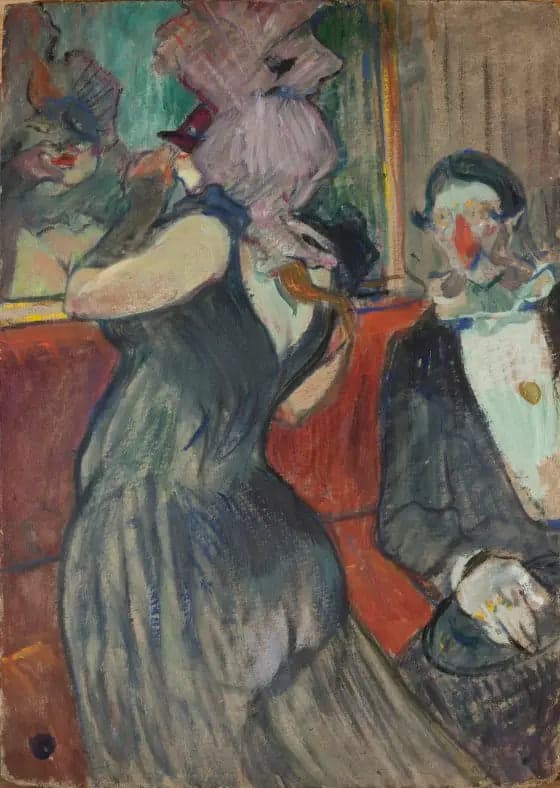
Resting during the masked ball - Henri de Toulouse
- Original dimensions
- 39.4 x 54.3 cm
- Museum
- Denver Art Museum
- Year
- 1899
Scene depicted
The painting “Rest during the masked ball” immortalizes a moment of calm amidst the festive turmoil. A man and a woman, surrounded by the richness of costumes and masks, find moments of tranquility. Their faces, imbued with melancholy, reveal a poignant contrast with the wild atmosphere surrounding them, creating a dialogue between euphoria and solitude.
Historical context
Created in 1899, this painting is set against the vibrant backdrop of Paris, at the height of the Belle Époque. Belonging to the post-impressionist movement, this canvas finely captures the effervescence of Parisian evenings, echoing a time when culture and art flourished like never before. Today, this painting is displayed at the Denver Art Museum , attesting to its timeless significance.
Place in the artist's career
This painting , a true stylistic peak of Toulouse-Lautrec's career, showcases his mastery of human movements and nocturnal atmospheres. Through “Rest during the masked ball,” the artist asserts himself alongside other masterpieces such as “At the Moulin Rouge” and “The Toilette,” illustrating his artistic evolution marked by an ever-deeper exploration of human emotions.
Anecdote
“Life is a theater and the masked ball, a festival of mysteries.” This quote, which could emanate from the brilliant mind of Toulouse-Lautrec, evokes the incredible atmosphere of a Parisian night. Imagine a masked ball in February, where laughter and whispers mingle with bursts of light. It is in this enchanting setting that the artist was inspired to create this pictorial work .