Regulus
- Original dimensions
- 123.8 x 89.5 cm
- Museum
- Tate Britain
- Year
- 1837
Scene depicted
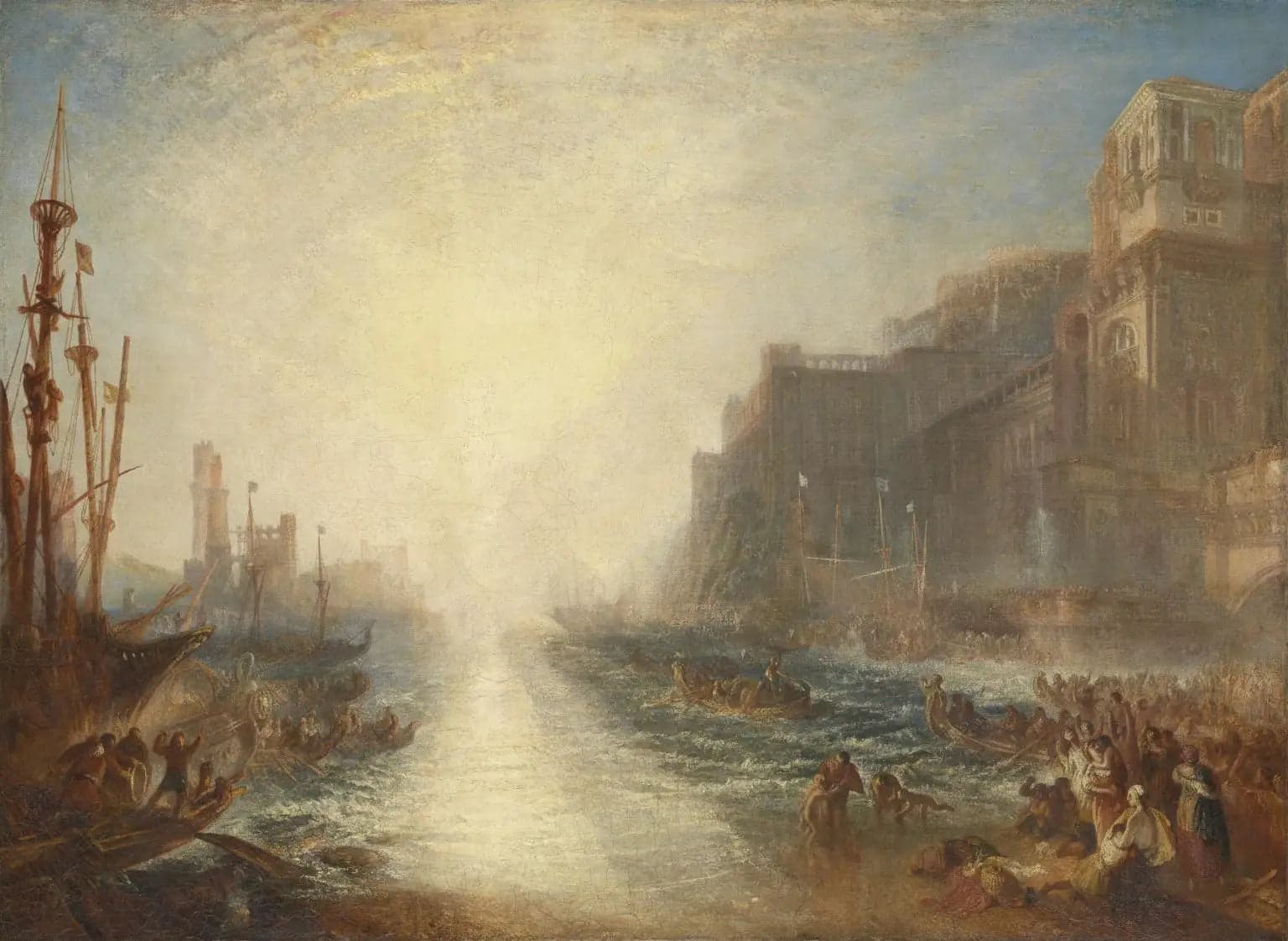
The painting captures a pivotal moment in Roman history, where Regulus, after defying the enemy, returns to Carthage, embodying loyalty. Turner transcends the simple historical narrative, offering a composition where light and shadow seem to dance, evoking both tragedy and grandeur.
Historical context
Created in 1837, in the midst of the Industrial Revolution, this painting is part of the romantic era in London, where Turner stands out for his unique approach to light and color. Today, the canvas majestically resides at the Tate Britain , a place of artistic wonder, measuring 123.8 x 89.5 cm.
Place in the artist's career
Regulus marks a significant evolution in Turner's career, reflecting his shift to a more lyrical expression. Alongside paintings such as The Storm and The Fighting Temeraire, it illustrates the rise of his chiaroscuro technique and his explorations of human emotions.
Anecdote
“Every brushstroke is an ode to the wonder of the world.” Inspired by the whisper of the waves and the bursts of light of a misty morning, Turner finds in this atmosphere his creative breath, uniting passion and finesse in his masterpiece .