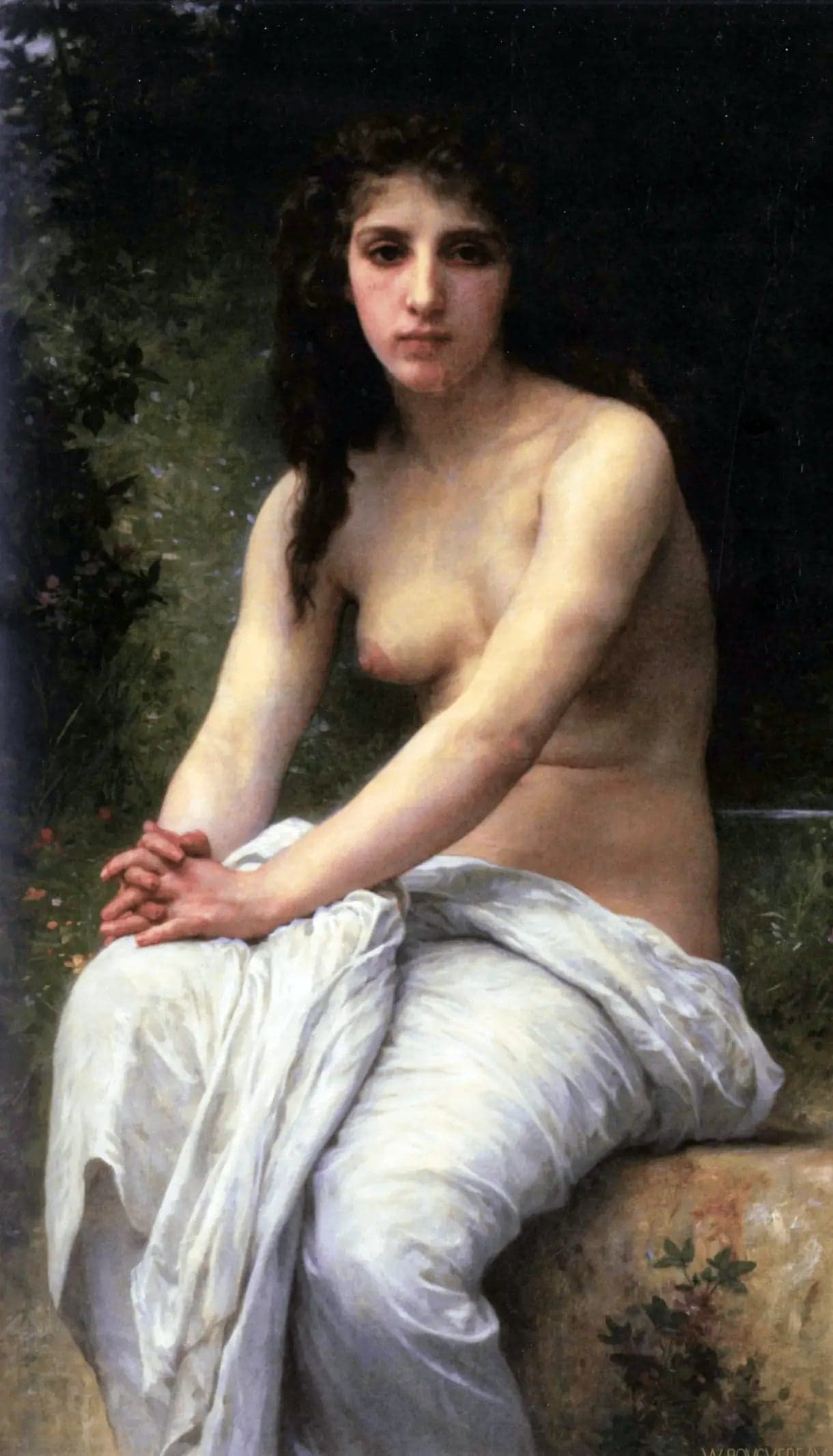
Reflection
- Original dimensions
- 73 x 117 cm
- Museum
- Not specified
- Year
- 1898
Scene depicted
The painting “Reflection” depicts a young woman in contemplation, lost in her thoughts. She rests elegantly, highlighting the beauty of the human body and the innocence of the mind. Bouguereau, the undisputed master of emotions, manages to capture the essence of her thought and transcribe it onto the canvas , making this moment both timeless and palpable.
Historical context
Created in 1898, this painting comes to life at the crossroads between the academic movement and the emergence of new artistic currents. Located in France, the homeland of arts par excellence, the work comes to life as the city is imbued with the poetic breath of the Belle Époque. Today, its canvas is preserved in private collections, paying tribute to its gestural and visual eloquence.
Place in the artist's career
“Reflection” stands as a pinnacle in Bouguereau's career. This painting surpasses his previous works such as “The Glutton” and “The Virgin under the Oak.” It testifies to his evolution towards an increasing mastery of light and human anatomy, rising towards artistic maturity and emotional depth.
Anecdote
William-Adolphe Bouguereau , often influenced by nature, reportedly stated: “Every masterpiece I create is a call to the sweetness of life, an invitation to look at the world with wonder.” Perhaps this canvas was inspired by the serenity of a sunny morning, where light plays between shadows and reflections, offering a delicate and touching scene to the eye.