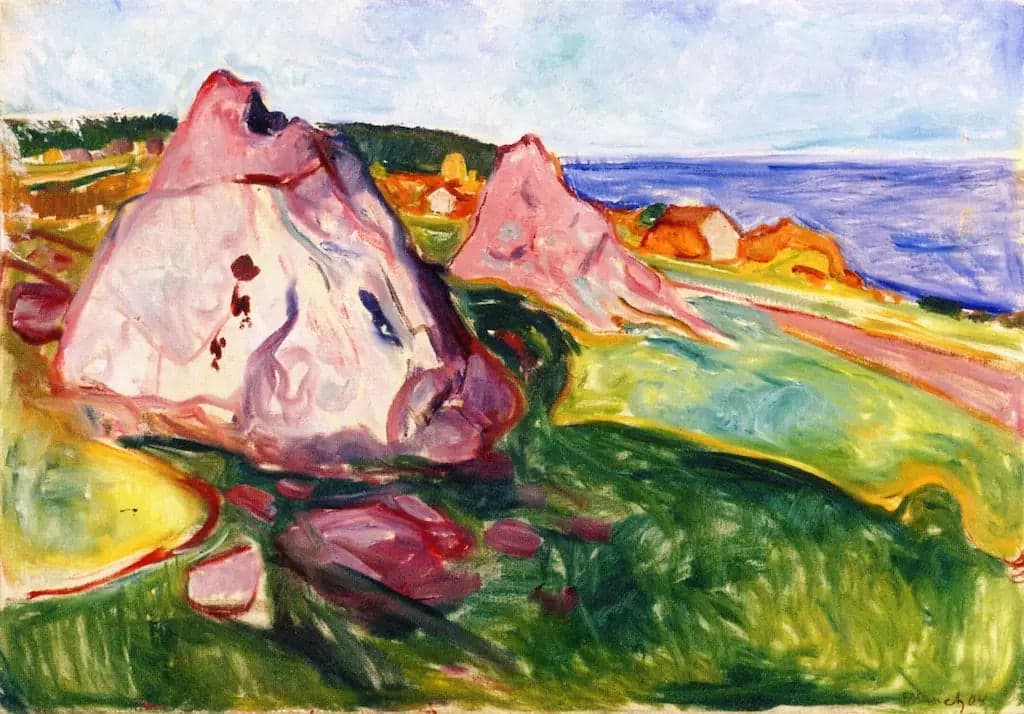
Red Rocks near Åsgårdstrand
- Original dimensions
- 100.5 x 70.5 cm
- Museum
- Munch Museum
- Year
- 1904
Scene depicted
In “Red Rocks near Åsgårdstrand,” Munch explores the dialectic between man and nature. The fiery rocks contrast with the calm of the sea, evoking a collision between earthly force and aquatic softness. This painting invites silent contemplation, where the colors vibrate in harmony with natural movements.
Historical context
Created in 1904, the iconic painting by Edvard Munch , “Red Rocks near Åsgårdstrand,” is located in the beautiful town of Åsgårdstrand, Norway. This painting is a perfect illustration of the expressionist movement, which was developing during this period. Currently exhibited at the Munch Museum in Oslo, this work measuring 100.5 x 70.5 cm reveals the artist's sensitivity and depth towards his environment.
Place in the artist's career
This painting represents a crucial turning point in Munch's career, marking a period of artistic maturity. At this time, he created other notable paintings such as “The Scream” and “The Madonna,” each revealing his unique sense of drama and emotion. “Red Rocks near Åsgårdstrand” thus fits into a stylistic and emotional continuity that reinforces his artistic legacy.
Anecdote
“Nature is a mirror of our emotions,” Edvard Munch might have confided. It was one spring morning, sitting facing the sea, that he perceived the glow of the rocks, bathed in a soft light. This pictorial work is a faithful reflection of the inspiration that this fairy-tale scene offered him, uniting the beauty of Norwegian landscapes and human emotion.