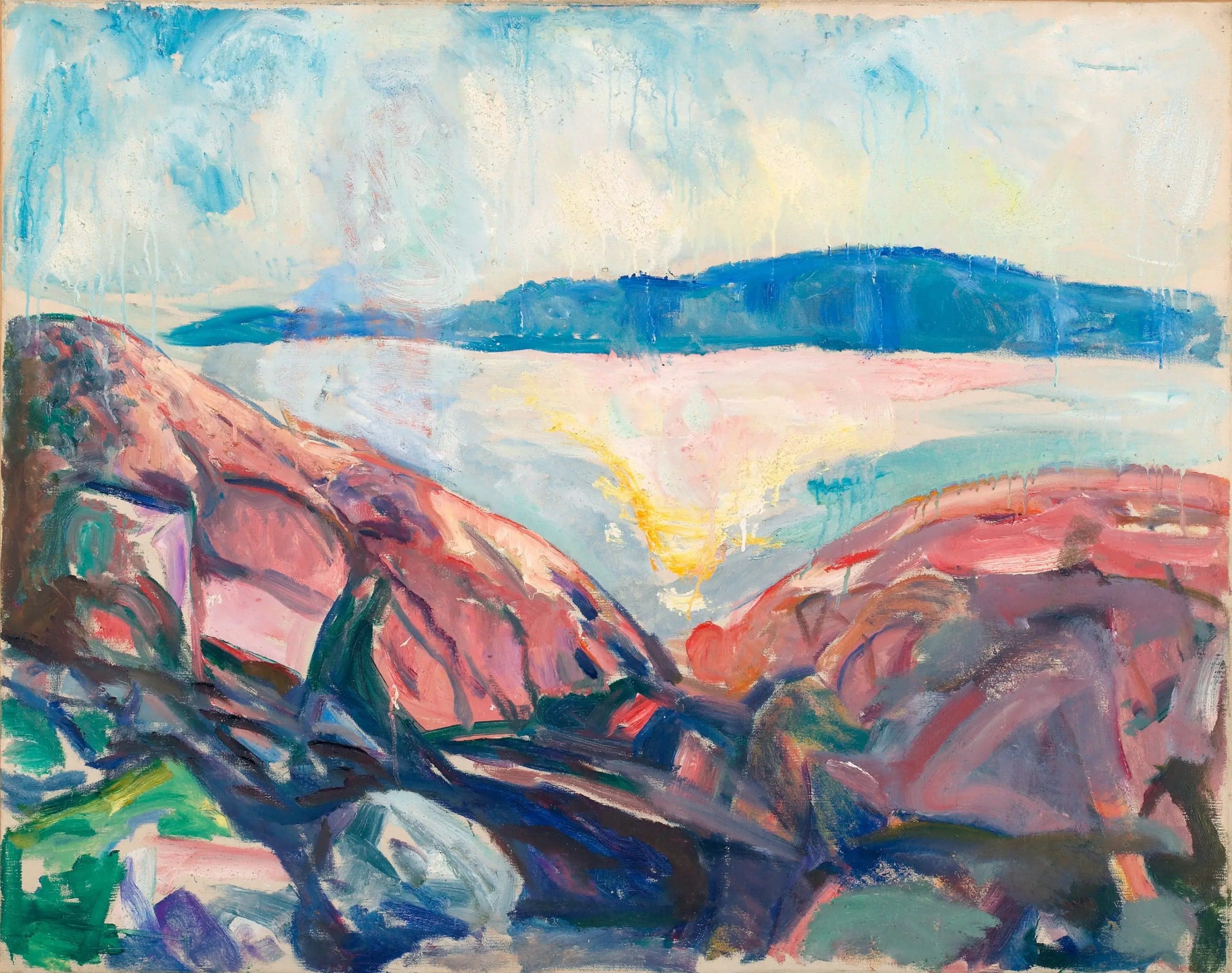
Red Rocks
- Original dimensions
- 120 x 95 cm
- Museum
- Munch Museum
- Year
- 1915
Scene depicted
In this work, Munch captures striking rocks, bathed in a glowing light that seems to vibrate with its own life. The composition reveals the contrasts of nature, as if it were whispering forgotten secrets, inviting the viewer to an introspective reflection on beauty and melancholy. The swirling forms and bold colors compose a scene that transcends mere landscape.
Historical context
Created in 1915, in the vibrant city of Oslo, this painting belongs to the period of Expressionism , a revolutionary artistic movement that sought to translate human emotions through color and form. The painting is currently located at the Munch Museum, an institution that celebrates the life and work of this iconic artist. With its dimensions of 120 x 95 cm, it is a canvas that attracts the eye and the mind.
Place in the artist's career
Red Rocks is situated at a turning point in Munch's career, symbolizing a stylistic peak of his Expressionism . Alongside other paintings like The Scream and The Madonna, this canvas illustrates a technical evolution of the artist, where each brushstroke becomes an emotional testimony of his unique sensitivity.
Anecdote
“At the heart of nature, I find the source of my emotions.” This phrase resonates when one thinks of the moment Munch painted his masterpiece. Perhaps on a sunny morning, as the colors of the rocks shimmered under a golden light, inspiration overwhelmed him, transforming reality into a vibrant pictorial work.