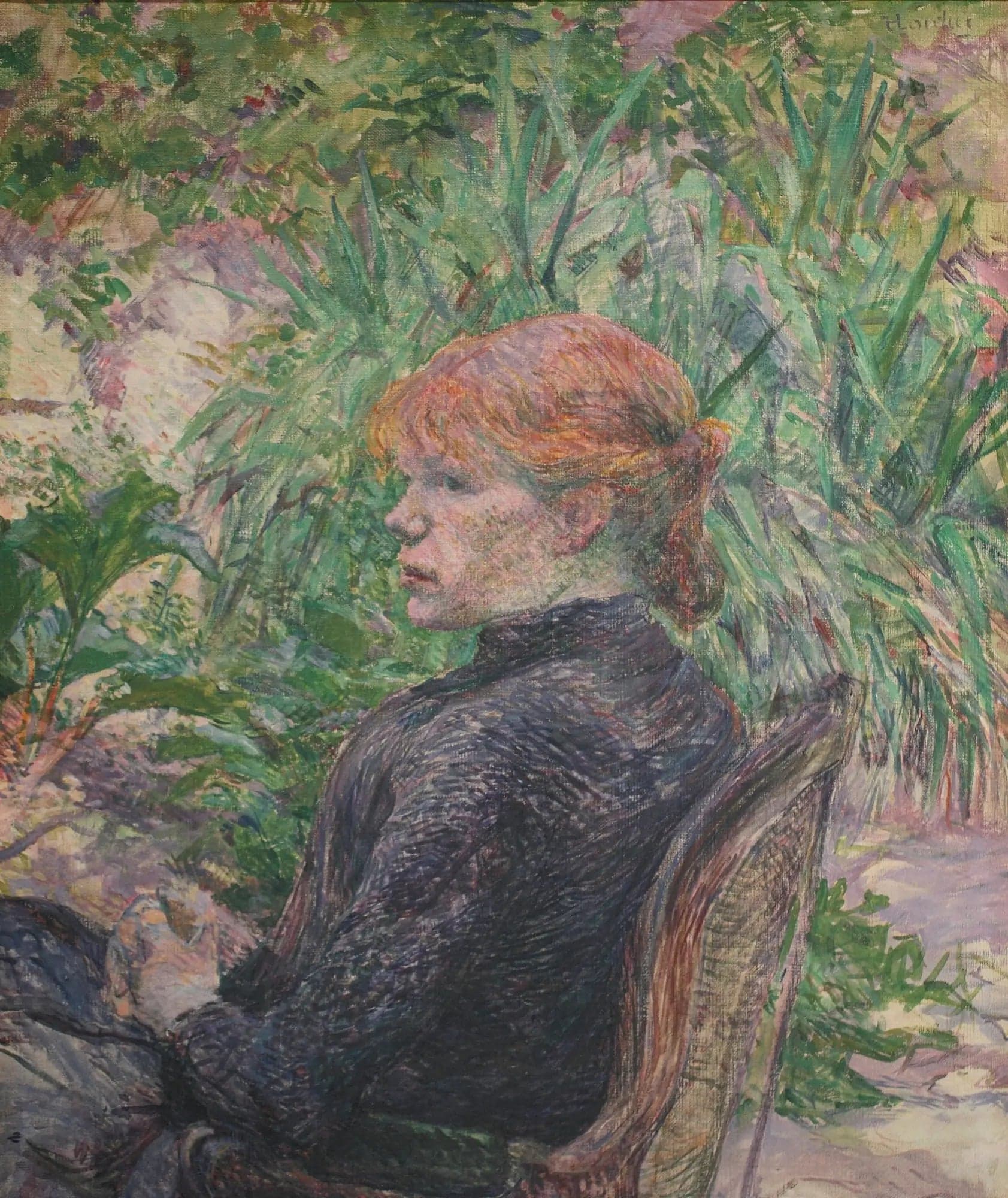
Red-haired woman sitting in Mr. Forest's garden - Henri de Toulouse
- Original dimensions
- 54 x 65 cm
- Museum
- Not specified
- Year
- 1889
Scene depicted
Red-haired Woman Sitting in Mr. Forest's Garden offers a representation imbued with serenity. The woman, delicately placed at the heart of a lush garden, seems lost in thought, surrounded by flourishing nature. This natural scene, almost theatrical, evokes atmospheres of rest and contemplation, captivating the gaze and the mind.
Historical context
Created in 1889 in the vibrant setting of Montmartre, this painting embodies the aesthetic of the Belle Époque. At a time when art was breaking free from conventions, Henri de Toulouse-Lautrec was part of the Post-Impressionist movement, subtly capturing the daily life and elegance of the women of his time. The canvas is now preserved in a private collection, with dimensions of 54 x 65 cm that give it an intimate presence.
Place in the artist's career
This canvas falls during a pivotal period for Toulouse-Lautrec, marked by his exploration of portraits and scenes of daily life. Parallel to works like At the Moulin Rouge and The Toilette , one observes an evolution in his technique and the emotions he conveys. In Red-haired Woman Sitting in Mr. Forest's Garden , the delicacy of a novice is illustrated alongside the expertise of a master.
Anecdote
“Beauty is often found where one least expects it, in the smallest details,” said Toulouse-Lautrec, evoking the fleeting moments that inspired him. Imagine him, one spring morning, the scents of flowers filling the air, as he sketches the delicate forms of a red-haired woman. Through the canvas , this moment becomes an ode to femininity, illuminating the painting with its gentle melancholy.
Major exhibitions
Private collections: A journey from Impressionists to Fauves