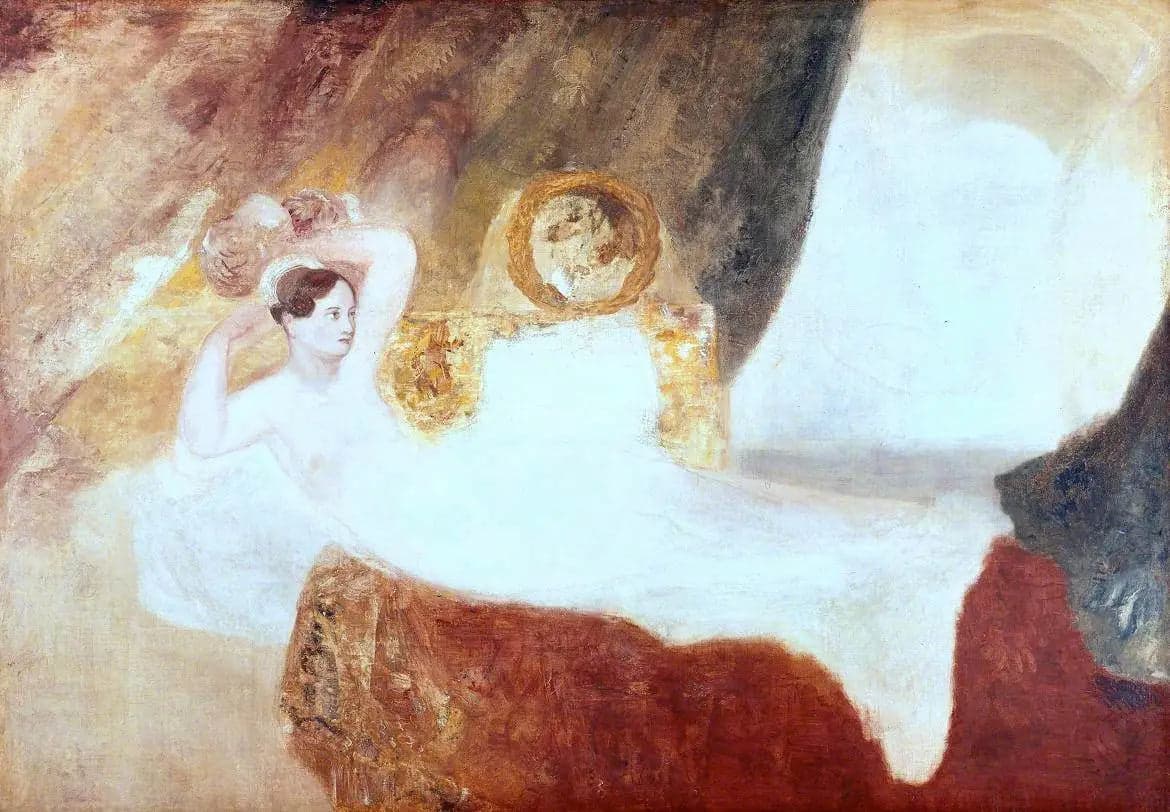
Reclining Venus
- Original dimensions
- 175.3 x 248.9 cm
- Museum
- Tate
- Year
- 1828
Scene depicted
In this canvas , Turner takes us to meet the embodied feminine beauty. Venus, reclining in celestial contemplation, stands majestically among lush nature. Her body and face are caressed by soft light, while the vibrant environment highlights the sensuality of the scene. Each brushstroke reveals textures, blending dream and reality in an enchanting harmony.
Historical context
Created in 1828, the famous canvas Reclining Venus emerges from the vibrant studios of London, the cradle of the romantic movement. At that time, Turner, master of light, draws his inspiration from the timeless beauty of the natural world and its indefinite reflections. This work is today carefully preserved at the Tate , a temple of art in London, and bears witness to the majestic dimensions of 175.3 by 248.9 cm that rival the depth of its subject.
Place in the artist's career
Reclining Venus represents one of Turner's iconic works, a return to a rich artistic sensitivity after his maritime explorations. Alongside other masterpieces such as The Storm and The Festival of the Sea , this painting illustrates a turning point towards spirituality and the expression of the sublime, each of these paintings testifying to the evolution of his art.
Anecdote
“Light is the key to everything,” said Turner. Inspired by a morning when the soft rays of the sun filtered through the branches of the trees, he wanted to capture on his painting the feeling of a suspended moment. This ethereal feeling, palpable in Reclining Venus , evokes the whispers of the wind and the reflections of calm waters.