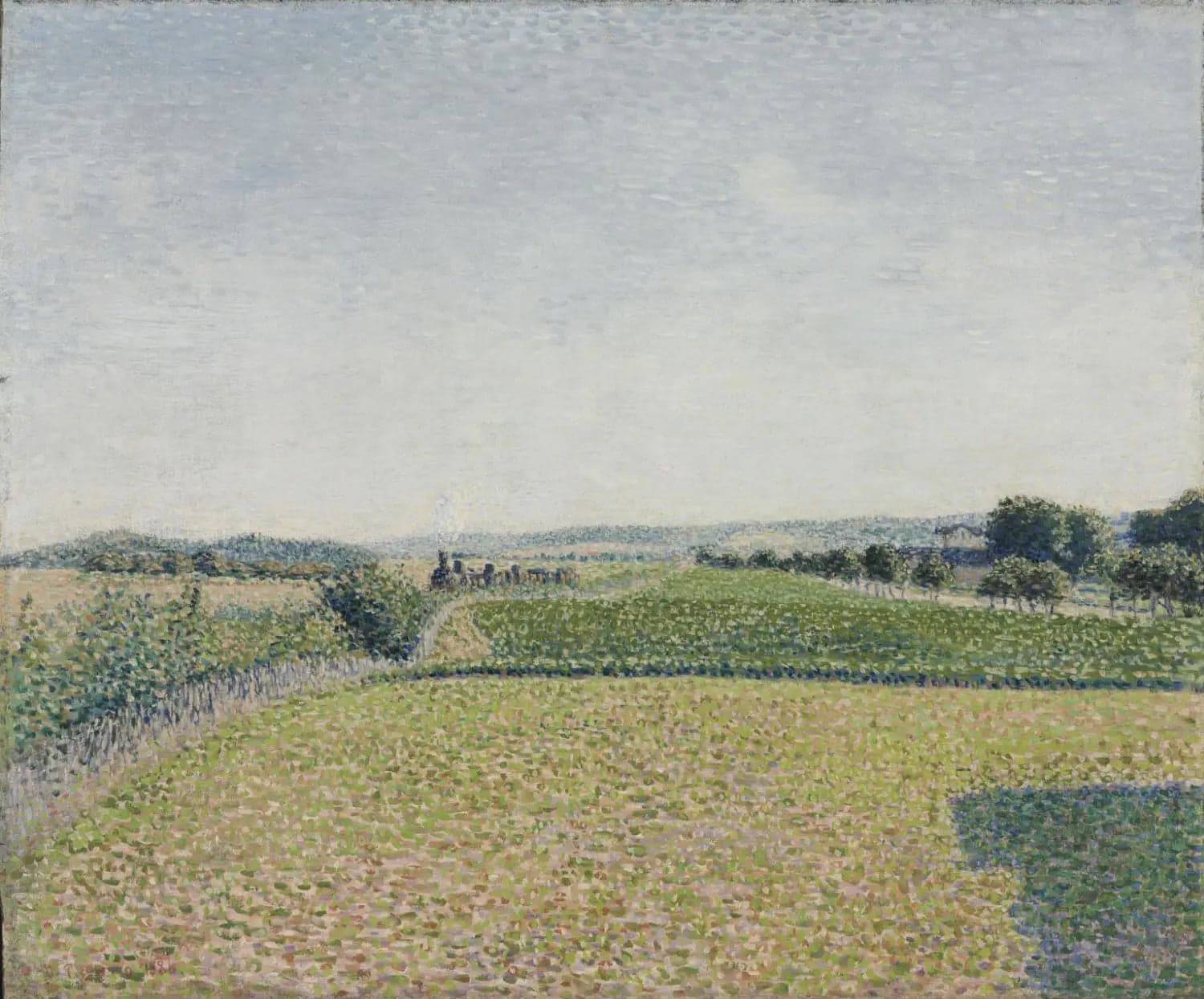
Railway to Dieppe
- Original dimensions
- 63.5 x 53.3 cm
- Museum
- Philadelphia Museum of Art
- Year
- 1886
Scene depicted
In this composition, Pissarro brilliantly depicts the effervescence of daily life in Dieppe. The railway, a symbol of modernity, faces the calm of the surrounding nature, creating a lively dialogue between man and his environment. The canvas reveals moving characters, images of smoking trains, while the light plays with colors, offering an unmatched sense of dynamism.
Historical context
Created in 1886 in the charming French town of Dieppe, this painting is part of the Impressionist movement, revolutionizing the art of the time through its play of light and scenes of everyday life. Through the fascinating gaze of Camille Pissarro , one of the masters of the movement, this canvas bears witness to a subtle blend of nature and industry, capturing the spirit of an era in full transformation. The painting is now preserved at the Philadelphia Museum of Art , a true sanctuary for art lovers.
Place in the artist's career
This painting represents a turning point in Pissarro's career, highlighting his exploration of themes related to urbanization and the coexistence of man and nature. It is part of a period of maturity for the artist, alongside other iconic canvases such as "The Apple Harvest" and "Boulevard Montmartre, Spring," where he refines his technique and emotional expression.
Anecdote
Pissarro once spoke of his passion for capturing light, stating: "I do not paint what I see, but what I feel." It was on a spring morning, by the railway tracks, that he was inspired by the gentle whisper of the wind and the song of the birds, both enveloping. A suspended moment that gave birth to this masterpiece , anchored in the collective memory of his time.