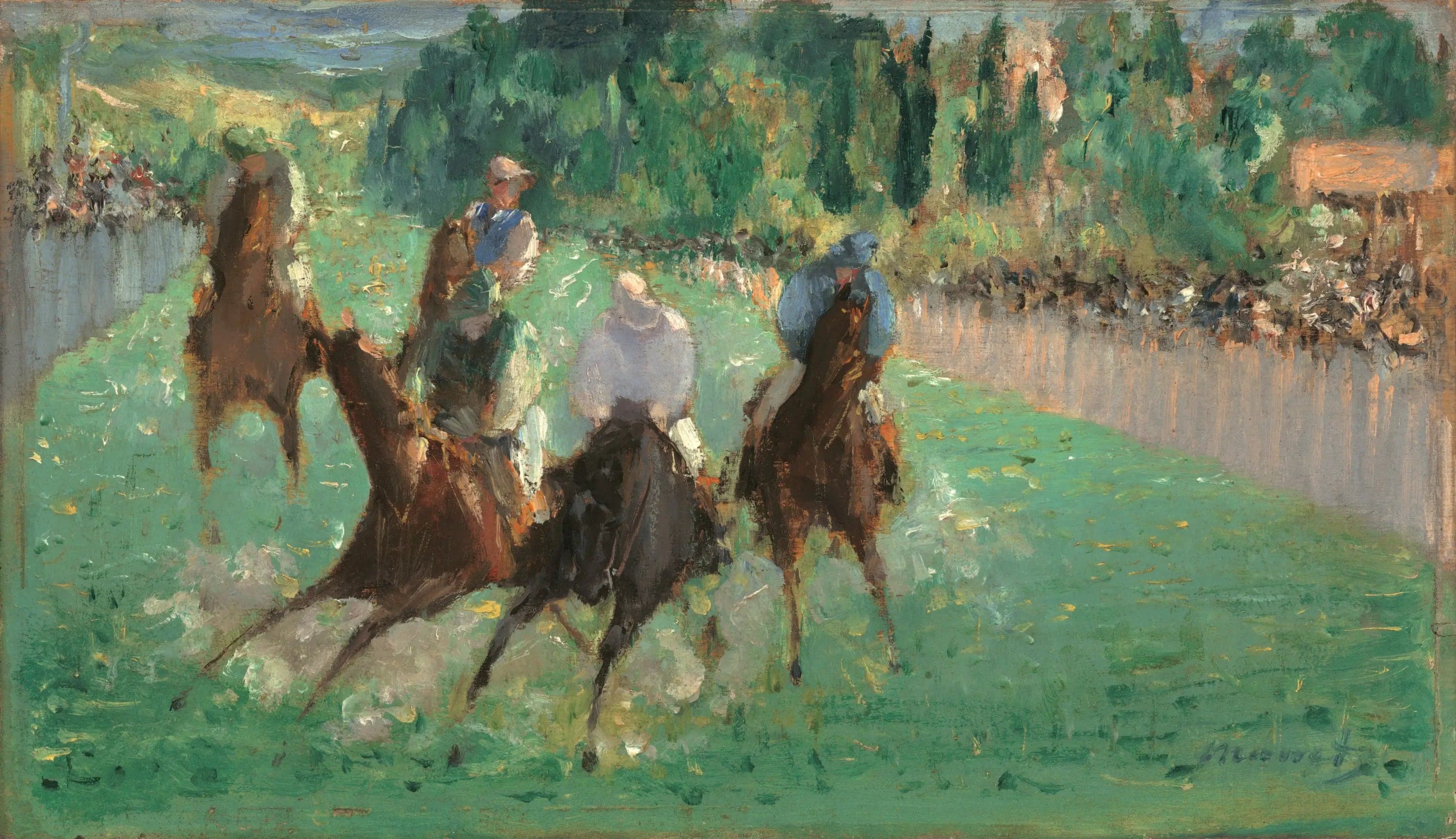
Races at Longchamp
- Original dimensions
- 21.9 x 12.6 cm
- Museum
- National Gallery of Art
- Year
- 1865
Scene depicted
The painting “Races at Longchamp” by Édouard Manet depicts a dynamic scene where the horses, bursting with power, race on the track. The artist's goal is not simply to represent the races, but to capture the vibrant essence of Parisian life at that time, blending elegance and effervescence.
Historical context
Created in 1865, the painting Races at Longchamp immerses us in the world of horse racing, a symbol of a Paris in full effervescence. Located in France, at Longchamp, this work belongs to the Impressionist movement that was developing at that time. Manet, a pioneer of this movement, brilliantly captures the immediacy of the scene. Currently exhibited at the National Gallery of Art , this vibrant painting testifies to a period when art began to break with tradition in order to capture movement and light.
Place in the artist's career
This painting is part of a pivotal period in Manet's career, marking a turn towards bolder compositions. Alongside other masterpieces like “Olympia” and “The Luncheon on the Grass,” Races at Longchamp reveals the evolution of his technique and his bold artistic explorations.
Anecdote
“Art feeds only on moments captured in flight,” said Manet. Perhaps it was on a spring morning, amidst the joyful crowds of the races, that he found inspiration for this painting. This quote resonates throughout the painting , reminding us of the vitality of a society in full transformation, captured in ephemeral light.