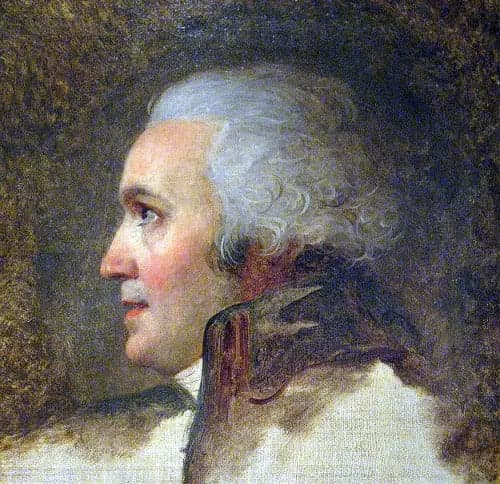
Rabaut Saint-Etienne - Jacques
- Original dimensions
- 42.2 x 55.2 cm
- Museum
- Huntington Library
- Year
- 1791
Scene depicted
In this painting , Jacques-Louis David illustrates a significant moment in the life of a fervent opponent of injustice, Rabaut Saint-Etienne, a major actor in social reforms. The painting bears witness to a profound humanity, where the subject is immersed in a posture of determination, inviting the viewer to reflect on the issues of civic engagement while celebrating the indomitable spirit of the Age of Enlightenment.
Historical context
Created in 1791 in Paris, this painting is emblematic of the neoclassical movement. At the heart of a tumultuous era, marked by the winds of the French Revolution, this canvas stands out for its exploration of themes of morality and virtue, which prevail within French society. Today, this masterpiece resides at the Huntington Library in San Marino, California, preserved in its magnificence with dimensions of 42.2 x 55.2 cm.
Place in the artist's career
Rabaut Saint-Etienne positions itself as a pivotal work in the career of Jacques-Louis David , illustrating a transition towards a pronounced artistic maturity. He places it in parallel with The Oath of the Horatii and The Massacre of the Innocents , showing a graphic and emotional evolution towards an increasingly powerful and engaged style, revealing with each brushstroke a deep philosophical and aesthetic reflection.
Anecdote
Jacques-Louis David , one spring morning, declared: "Art must awaken souls and nourish the intellect." It is in this quest for beauty and truth that he embarked on the creation of Rabaut Saint-Etienne , seeking to capture the essence of a historical figure while reflecting the turpitudes of his time. This canvas thus becomes a symbol of David's artistic commitment to his era.