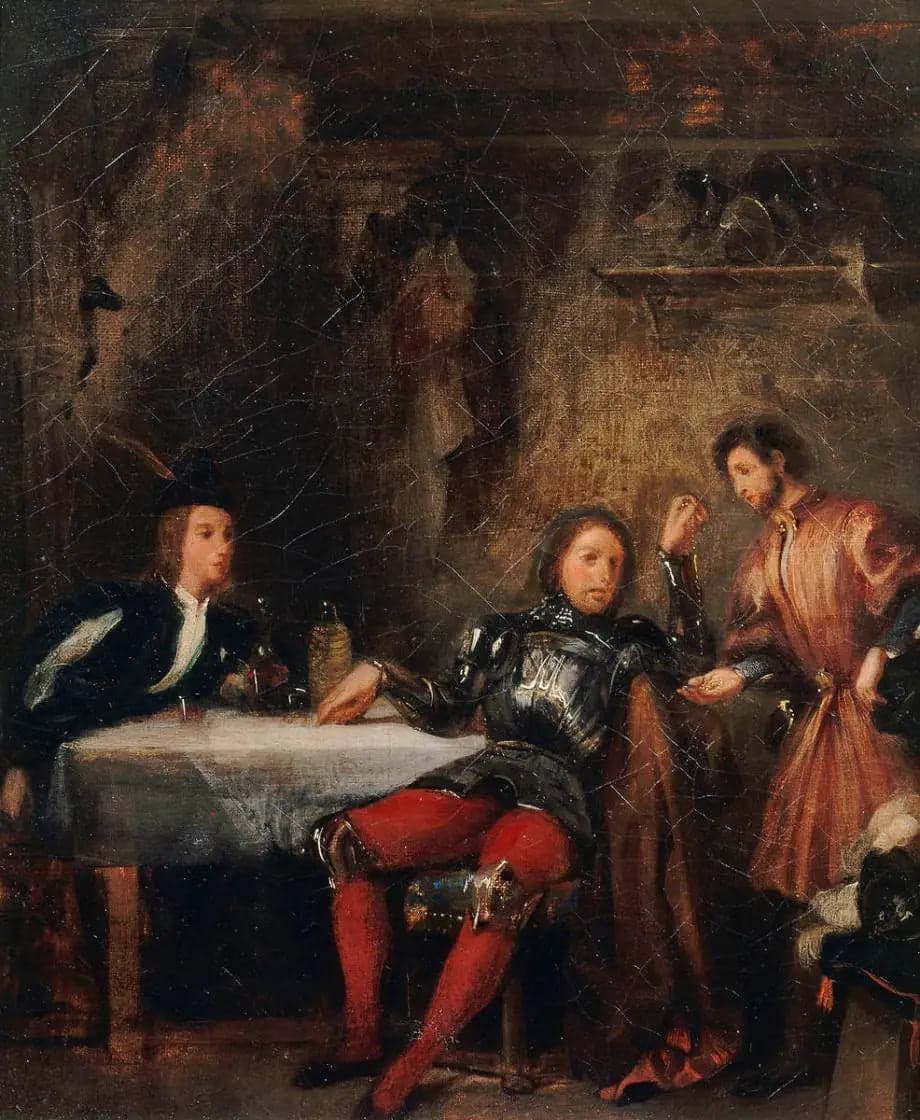
Quentin Durward and the Scarred One
- Original dimensions
- 32 x 41 cm
- Museum
- Caen Museum of Fine Arts
- Year
- 1828
Scene depicted
This pictorial work depicts the protagonist of Walter Scott, Quentin Durward, in an intense scene. The painting captures the dramatic moment of an encounter with a scarred man, an impressive figure who seems to impose his presence. The gaze of the characters, the expression of fear and bravery, all evoke a narrative rich in emotions, transporting the viewer into a universe where intrigue and bravery intersect strikingly.
Historical context
Created in 1828, during a time when Romanticism was in full swing, Quentin Durward and the Scarred Man stands out as a major painting by Eugène Delacroix , an iconic artist of his time. In Caen, at the heart of Normandy, this work illustrates the upheaval of artistic and literary sensibilities, diving into a captivating history, while today it is revealed to the public in the Museum of Fine Arts. Its dimensions, 32 x 41 cm, allow it to gently integrate into the artistic panorama of the century that witnessed its birth.
Place in the artist's career
Quentin Durward and the Scarred Man represents a crucial step in Delacroix's career. Emerging from a promising start, this painting is both a stylistic peak and a reflection of his maturity. In parallel, works such as Liberty Leading the People and Women of Algiers in Their Apartment reveal the technical and emotional evolution of the artist, showcasing the bold innovations of his style and his exploration of romantic themes.
Anecdote
“Art must reflect the tumult of emotions,” Delacroix once said in one of his reflections. It was at dawn on a bright morning, as shadows danced on the cobblestones of an alley, that he captured the vibrant essence of the canvas . Infusing a scene full of passion, this is where the energy of Quentin Durward and the Scarred Man is drawn, revealing the tensions and intrigues of a bygone era.