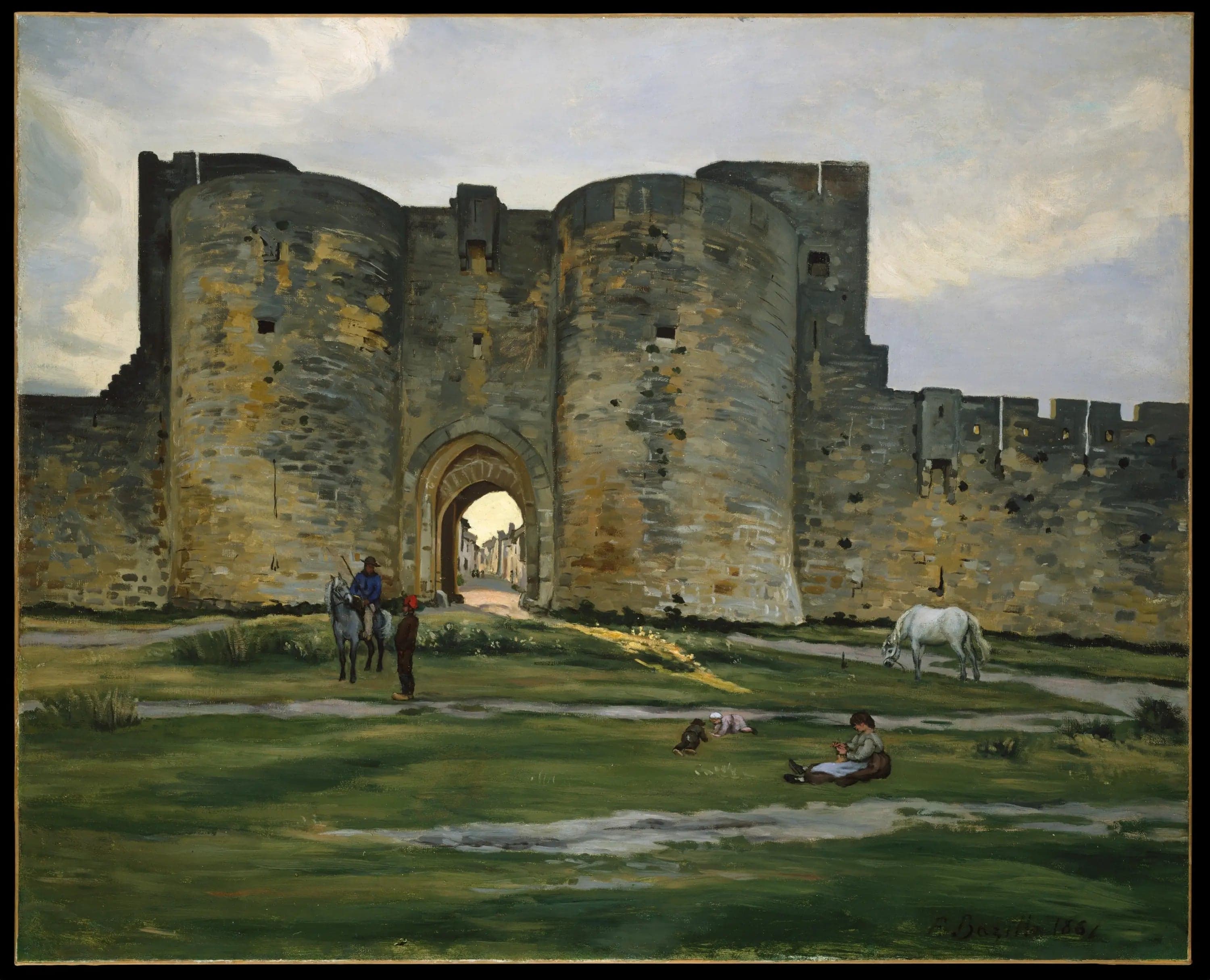
Queen's Gate in Aigues-Mortes
- Original dimensions
- 99.7 x 80.6 cm
- Museum
- Metropolitan Museum of Art
- Year
- 1867
Scene depicted
In this pictorial work , Bazille immortalizes the majestic Porte de la Reine, all imbued with light. The scene evokes the tranquility of a moment suspended in time, where medieval architecture rises as a symbol of resistance and history, surrounded by the serenity of the surrounding landscapes. The delicate and colorful brushstrokes convey this unique atmosphere, elevating this canvas to the rank of an unforgettable work of art.
Historical context
Created in 1867, the painting titled Porte de la Reine à Aigues-Mortes evokes a striking moment in artistic history. Located in the charming town of Aigues-Mortes, in the Occitanie region, this work perfectly fits within the impressionist movement, which emerged during a time rich in reforms and social innovations. Today, the canvas is part of the prestigious collections of the Metropolitan Museum of Art , where it is admired by thousands of visitors each year.
Place in the artist's career
Porte de la Reine à Aigues-Mortes represents a key milestone in the career of Frédéric Bazille , a promising artist lost too soon. This painting is both a reflection of his exceptional talent and a bridge between his early works, such as La Répartition des légumes , and his later masterpiece, Les Baigneuses . It illustrates the evolution of his artistic approach, blending sensitivity and innovation.
Anecdote
“The light of that morning struck me, I knew that this canvas had to capture the brilliance and magic of the moment.” Frédéric Bazille found his inspiration during a morning walk in Aigues-Mortes, the scent of flowers and the song of birds enveloping his creative spirit. This painting testifies to a moment of pure wonder, inviting the viewer to share this transmissible emotion.