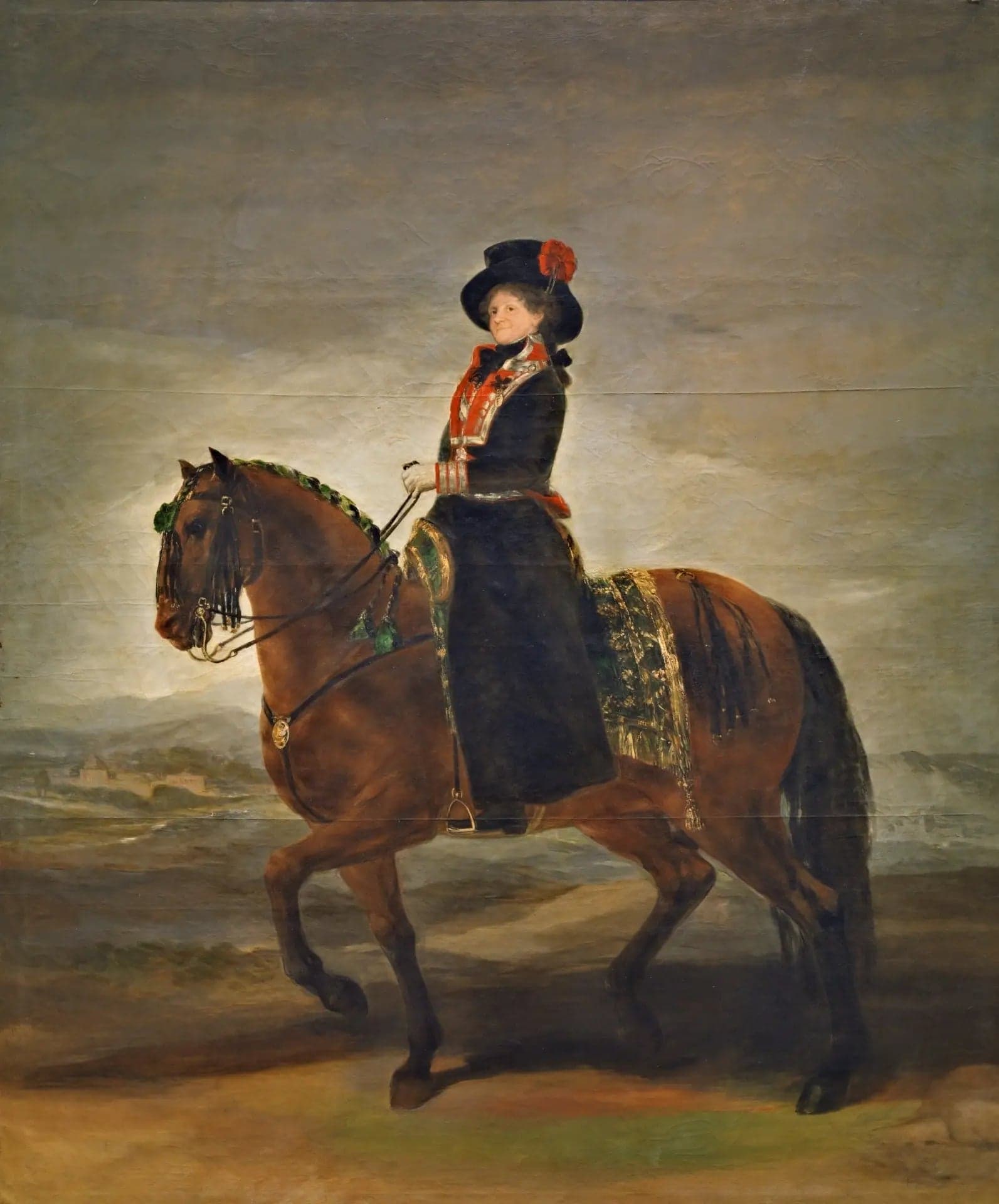
Queen María Luisa on Horseback
- Original dimensions
- 282 x 338 cm
- Museum
- Royal Palace of Madrid
- Year
- 1799
Scene depicted
This majestic canvas highlights Queen María Luisa, drawing beauty from her black horse while showcasing the elegance of a nobility in motion. The composition reflects authority and femininity, uniting the majesty of royalty with the grace of her subject in this fascinating painting.
Historical context
Created in 1799 in Madrid, this iconic painting belonging to the romantic movement is an integral part of Spanish artistic heritage. It is currently housed in the Royal Palace of Madrid, a true testament to the magnificence of the Spanish court at the end of the 18th century.
Place in the artist's career
The Queen María Luisa on Horseback marks a turning point in Goya's career, where he combines his romantic style with a representation of figures of power. Through works such as The Naked Maja and The Family of Charles IV, Goya explores similar themes, weaving a narrative thread of sophistication and psychological revelation.
Anecdote
Goya once stated: “Art is the most beautiful of illusions,” thus evoking the evocative power of his works. It is in an embrace of soft light and court whispers, under a spring sky, that he captured the essence of María Luisa, the equestrian queen, embodiment of regal grace.