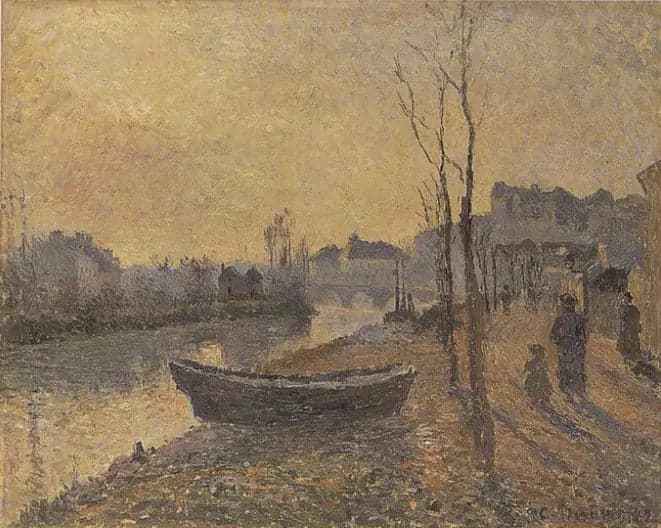
Quai du Pothuis, banks of the Oise
- Original dimensions
- 55.5 x 46.5 cm
- Movement
- impressionism
- Museum
- André-Malraux Museum of Modern Art
- Year
- 1882
Scene depicted
In Quai du Pothuis, bords de l'Oise , Pissarro depicts a spring scene where boats anchor peacefully along the banks. The laughter of children playing on the quay, the gentle rustling of leaves in the wind, and the song of birds in the background create a sensory symphony. The painting immerses us in a moment of serenity where the harmony between man and nature is brilliantly manifested. Each brushstroke evokes not only the landscape but also the life that surrounds it, making this painting a true reflection of the era.
Historical context
Created in 1882, this painting unfolds on the peaceful banks of the Oise, in Pontoise, a city steeped in history and enchanting landscapes. As the impressionist movement is in full swing, Camille Pissarro asserts himself as a pioneer, capturing the light and colors of nature with an innovative eye. Today, this iconic work is preserved at the André-Malraux Museum of Modern Art , whose walls house countless artistic treasures. Its dimensions of 55.5 x 46.5 cm make it a canvas of striking beauty, which transports the viewer directly to the heart of this idyllic setting.
Place in the artist's career
Quai du Pothuis, bords de l'Oise occupies a cemented place in Pissarro's career, representing a period of maturation in his work. The freedom of his touch and his bold palette anticipate the grand compositions that will come. By paralleling it with The Hay Harvest and The Gardens of the Impressionist , we understand how his style has refined over time, both technically and emotionally.
Anecdote
“Nature, with its light and colors, calls me at every moment.” These words say everything about the very essence of Pissarro's inspiration. That day, a spring morning, he was captivated by the softness of the sun's rays filtering through the branches of the trees, illuminating the peaceful surface of the Oise. This delicate and ephemeral atmosphere was perfectly translated into the evocative power of Quai du Pothuis, bords de l'Oise , making this masterpiece a living testament to his passion for nature.