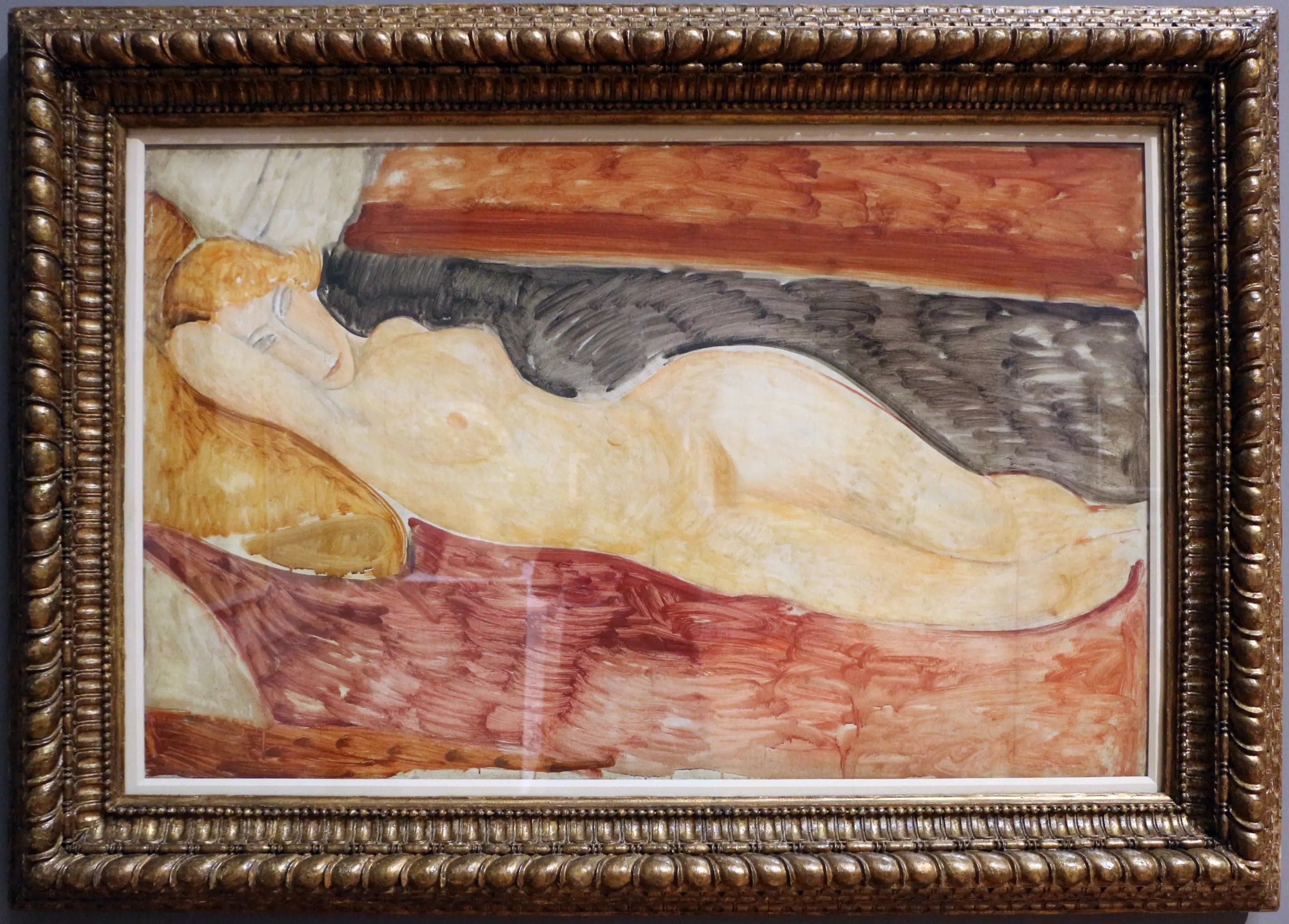
Q125425632
- Original dimensions
- 116 x 73 cm
- Museum
- National Gallery of Modern and Contemporary Art
- Year
- 1918
Scene depicted
This canvas embodies a portrait imbued with melancholy, where the elongated shapes of the faces, characteristic of the Modigliani style, intertwine with psychological intensity. The warm hues and fluid lines offer a deep and poetic contemplation of the subject, an ode to fleeting beauty and human introspection. The work captures a precious moment, frozen forever in the dynamics of light and emotion.
Historical context
Created in 1918, in the vibrant setting of Montparnasse, a neighborhood in Paris that became the beating heart of avant-garde art, this painting belongs to the movement of modernism . It was a time when experimentation and the quest for pure beauty shaped the artists of the era. Today, the canvas is preserved at the National Gallery of Modern and Contemporary Art, affirming its place in modern artistic history.
Place in the artist's career
The painting “Q125425632” is situated at a major turning point in Modigliani's career, illustrating a maturity in his technique and a depth of feeling. Compared to other works such as “The Young Girl at the Column” and “Young Girl in a Red Dress,” this painting reflects a stylistic evolution where the artist strengthens his exploration of human forms, blending abstraction and reality with palpable emotion.
Anecdote
“Beauty is not in the form, but in the soul that we reveal,” Modigliani is said to have remarked about his aesthetic quest. At the dawn of a spring morning, facing the Parisian light that bathed the street, an inspiration emerging from a mundane conversation with a muse led to the creation of this masterpiece , resonating with powerful vibrations, palpable human emotions.