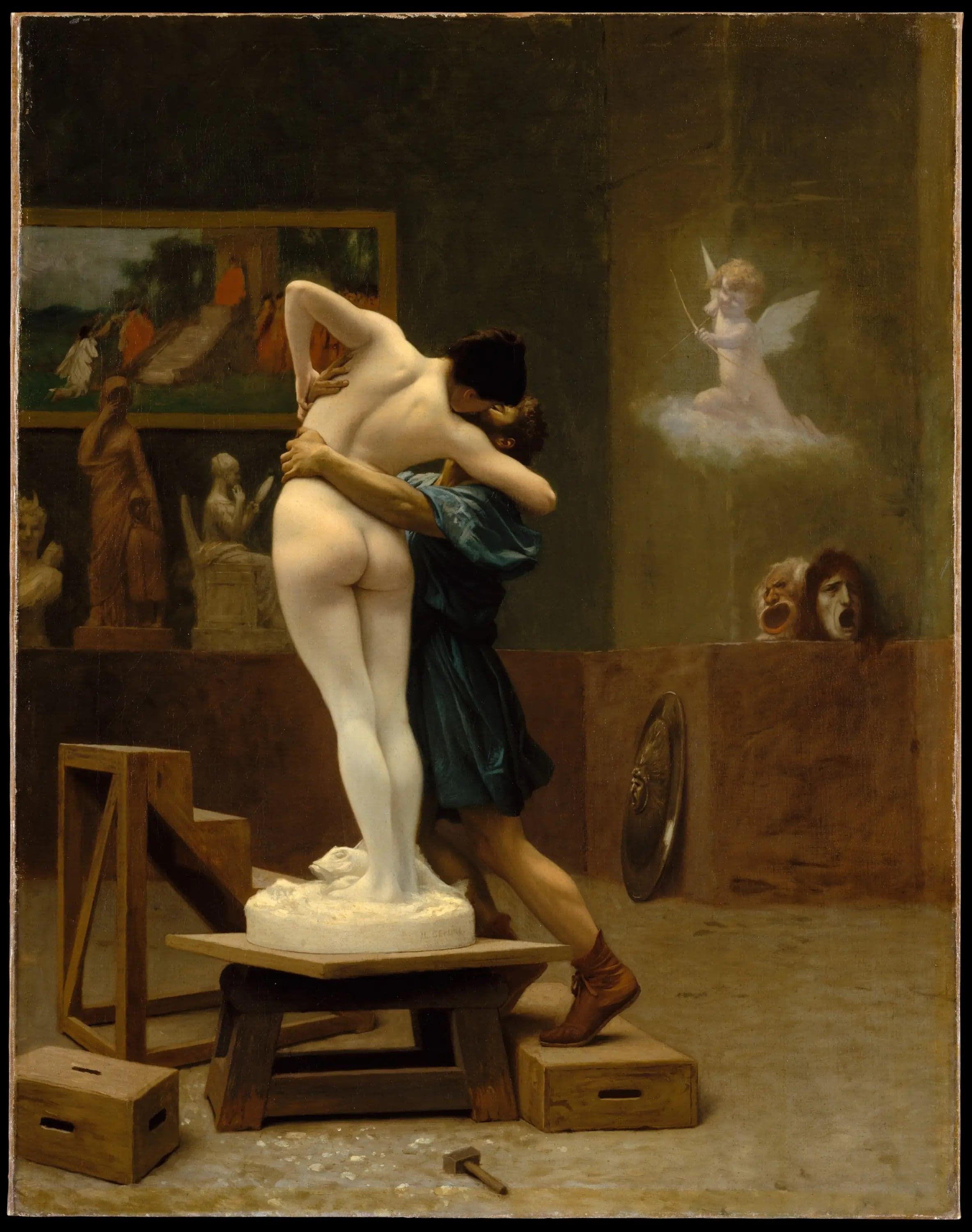
Pygmalion and Galatea - Jean
- Original dimensions
- 74 x 94 cm
- Movement
- academicism
- Museum
- http://www.wikidata.org/.well-known/genid/69734679a80e1f79bb28eee7332cf902
- Year
- 1890
Scene depicted
The painting “Pygmalion and Galatea,” an emotionally rich pictorial work, tells the story of a sculptor, Pygmalion, who falls in love with his own creation, Galatea, a statue of unmatched beauty. In a moment of delicacy, he implores the gods to give her life. The painting captures this tragic and tender moment, revealing the passion and desire to give art a vibrant soul, echoing the artist's eternal quest for immortality.
Historical context
Created in 1890, this painting is the result of an era marked by refinement and artisanal know-how in Paris, the capital of art. At the heart of the academicist movement, the canvas reflects the aesthetic and cultural values of its time. Currently, this canvas is found in a prestigious collection, where it continues to evoke the magic and passion of the mythological narrative it depicts.
Place in the artist's career
“Pygmalion and Galatea” is intended to be the pinnacle of Gérôme's career, marking his technical and emotional mastery. At this time, he also creates other iconic paintings such as “The Education of the Virgin” and “The Death of Caesar,” which testify to his artistic evolution and his ability to marry classical themes with striking realism .
Anecdote
“Art is a reflection of our soul,” said Gérôme, captivated by the pursuit of beauty through the harmony of forms and colors. It was on a sunny morning, surrounded by the golden lights of his studio, that he conceived the idea for this iconic composition, inspired by the timelessness of the legend of Pygmalion, himself a creator in love with his work.