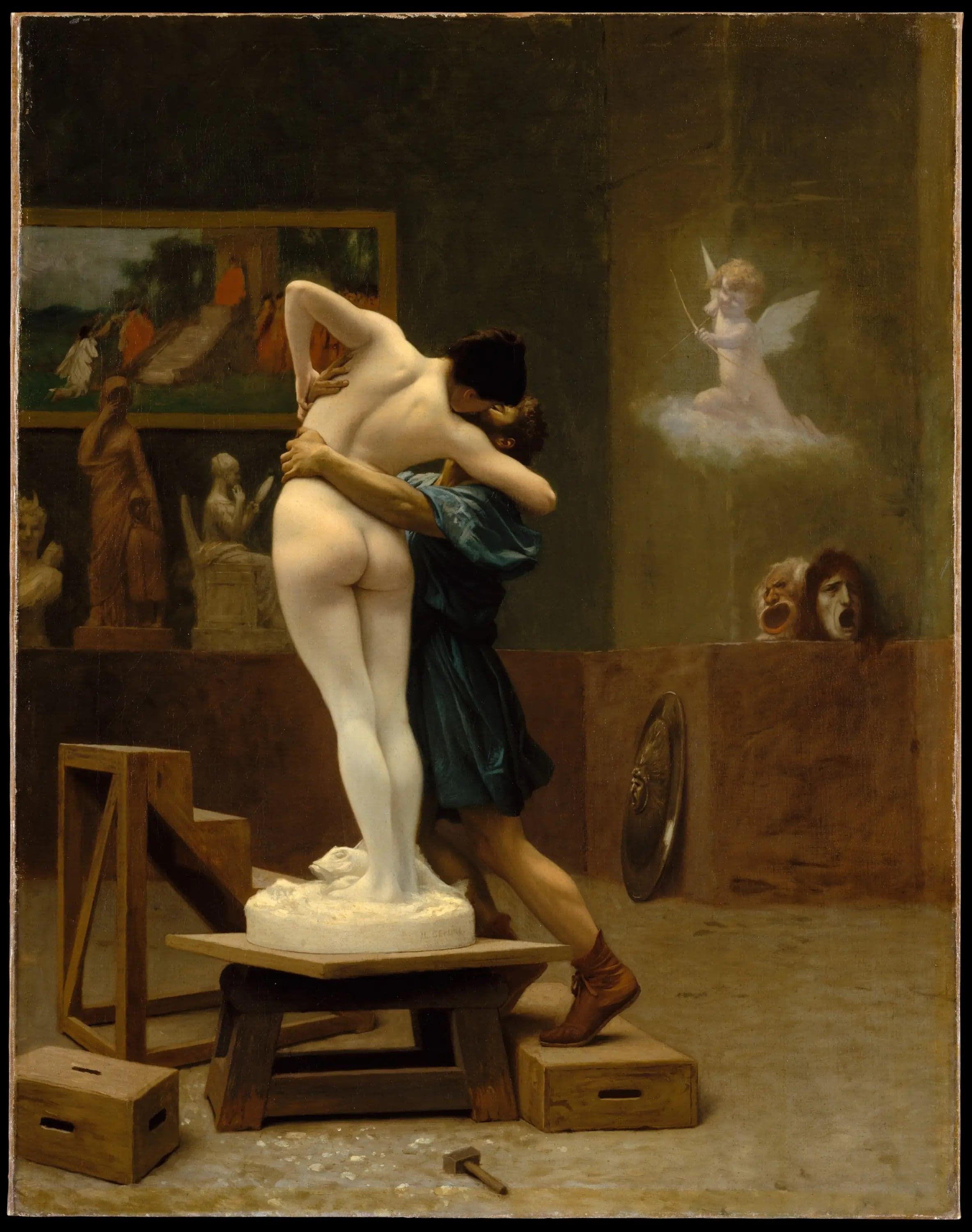
Pygmalion and Galatea - Jean
- Original dimensions
- 68.6 x 88.9 cm
- Movement
- academicism
- Museum
- Metropolitan Museum of Art
- Year
- 1890
Scene depicted
At the heart of this canvas , we discover the story of Pygmalion, a sculptor in love with his own creation, Galatea, a statue of unparalleled beauty. The scene captures the carnal moment when Pygmalion's passion transforms into a palpable life, as Aphrodite grants his wish, breathing soul into the canvas . Eyes meet, hearts race. This is not just a painting ; it is a visual narrative of love and transcendence.
Historical context
Created in 1890, this painting emblematic was born in Paris, the flagship city of European art, in a context where academicism imposes itself as the dominant current. Pygmalion and Galatea is part of a time rich in artistic expressions, where Gérôme's art reflects a sophisticated know-how, marking a turning point in the understanding of visual representation. Today, this canvas resides majestically at the Metropolitan Museum of Art , a New York showcase that celebrates the beauty and complexity of Gérôme's work.
Place in the artist's career
Pygmalion and Galatea represents a peak in Gérôme's career, illustrating his technical expertise and narrative approach. Like Pollice verso and The Duel of Gladiators , this canvas testifies to the artist's evolution towards palpable refinement. Each painting retraces a journey of emotions and techniques, making Gérôme an undeniable master of his time.
Anecdote
It is said that Gérôme once declared, "Art must be a mirror of life, nourished by human passions and the beauty of the world." It was on a radiant morning, as he wandered through the bustling alleys of the East, that he found inspiration for this masterpiece . This fleeting moment of beauty and dream profoundly marked the painting to come.