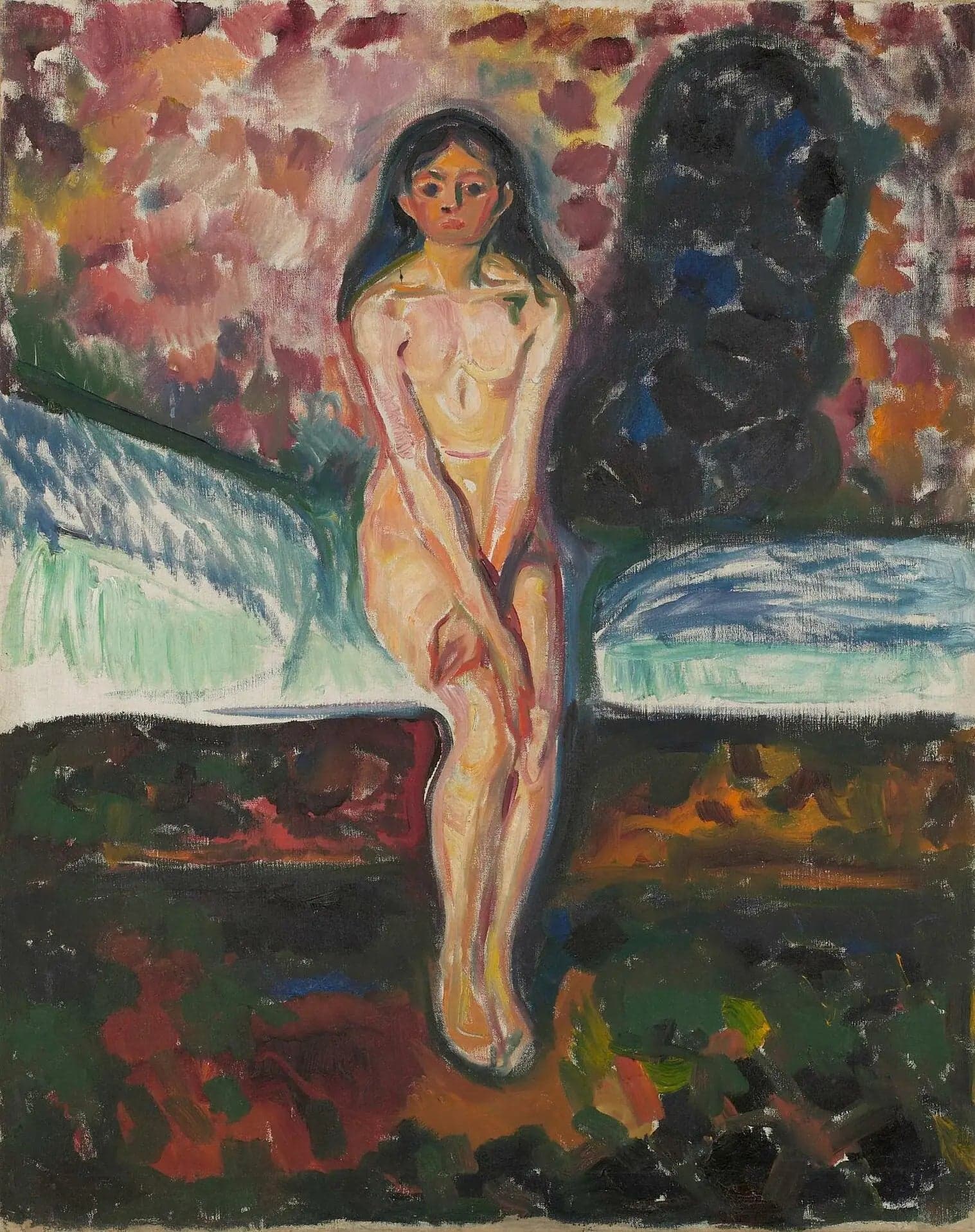
Puberty
- Original dimensions
- 112.5 x 150 cm
- Museum
- Munch Museum
- Year
- 1894
Scene depicted
The painting “Puberty” depicts a scene of disarming intensity, highlighting a young girl meditating on the tumult of her transition to adulthood. In this pictorial work , the central figure, both fragile and strong, seems immersed in her thoughts, surrounded by a world that eludes her. The underlying emotional stakes of growing up are expressed through the composition and colors, transporting the viewer on an introspective journey.
Historical context
Created in 1894, this painting is deeply rooted in the artistic landscape of Oslo, then Christiania, in the heart of Norway. Munch, a major figure of symbolism , captured the torments of the human soul, making this canvas a poignant representation of the emotions of adolescence. Currently exhibited at the Munch Museum, this painting with imposing dimensions of 112.5 by 150 centimeters continues to evoke deep and universal feelings.
Place in the artist's career
“Puberty” stands as a fundamental milestone in the career of Edvard Munch , marking a period of stylistic exploration and personal introspection. Through this canvas , one can compare it to the poignant “The Scream,” which shares a similar quest for the expression of human emotions. In parallel, “The Madonna” illustrates the artist's tendency towards a bolder approach to sensuality and pain, contrasting with the innocent vulnerability of “Puberty.”
Anecdote
“Life is a struggle between joy and sadness.” This quote from Munch may have arisen during a walk in a park in the light of a spring morning. In this vibrant and emotionally charged atmosphere, he may have crossed the gaze of a young girl, thus capturing the very essence of the painting . The masterpiece “Puberty” resonates with this fleeting moment.