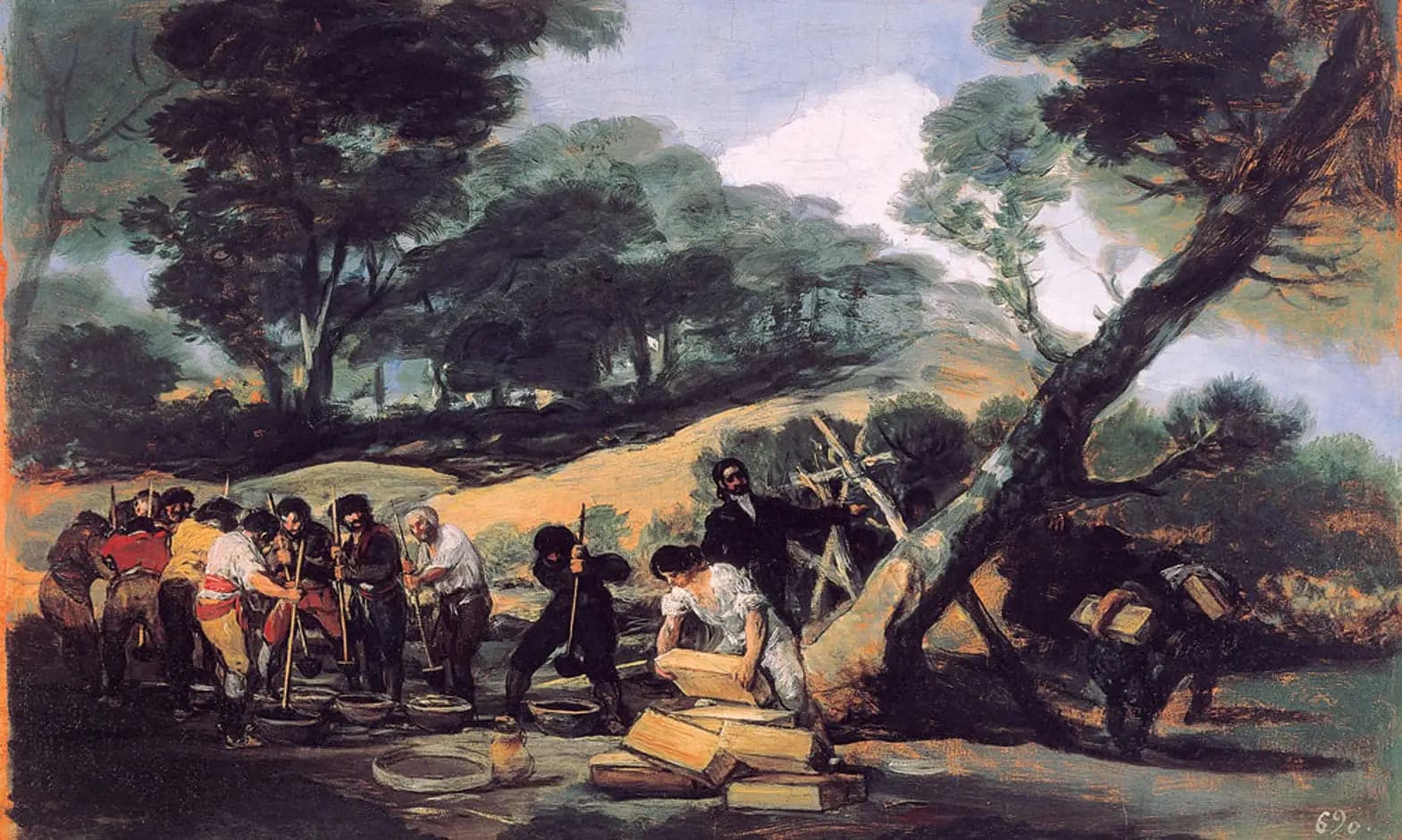
Production of Powder in the Sierra de Tardienta
- Original dimensions
- 52 x 33 cm
- Museum
- Royal Monastery of San Lorenzo de El Escorial
- Year
- 1814
Scene depicted
The painting “Gunpowder Production in the Sierra de Tardienta” immerses the viewer in a crucial incident of gunpowder production, a recurring theme in Goya's works. The artist depicts laborious figures, absorbed in an energetic task, where the surrounding nature interacts with human strength. This evocative painting blurs the lines between labor and power, highlighting the social struggles of its time.
Historical context
Painted in 1814, this work emblematic of Goya emerges at a pivotal time, at the crossroads between neoclassicism and romanticism . It transports us to the Sierra de Tardienta, a rural region of Spain, steeped in the history of independence wars and renewal. Currently, the painting rests in the Royal Monastery of San Lorenzo de El Escorial, a sanctuary of culture and art that gives it a sacred dimension. Its dimensions, 52 x 33 cm, invite an intimate contemplation of every detail of this unique composition.
Place in the artist's career
This painting on gunpowder production is situated in Goya's mature period, illustrating his transition from a classical approach to a more personal interpretation of the themes of his time. As in “The Executions of May 3, 1808” and “The Colossus,” this canvas refines his technique, using bold colors and striking contrasts that have cemented his place in the history of art.
Anecdote
Goya once stated: “True inspiration lies in nature and its silent whisper.” It was during a morning when the heat of the Spanish summer mingled with the scent of wild herbs that the idea for this painting sprang to life within him. Trapped between the mountains, this fleeting moment of artistic awakening gave birth to a vibrant canvas , where light plays with shadows.