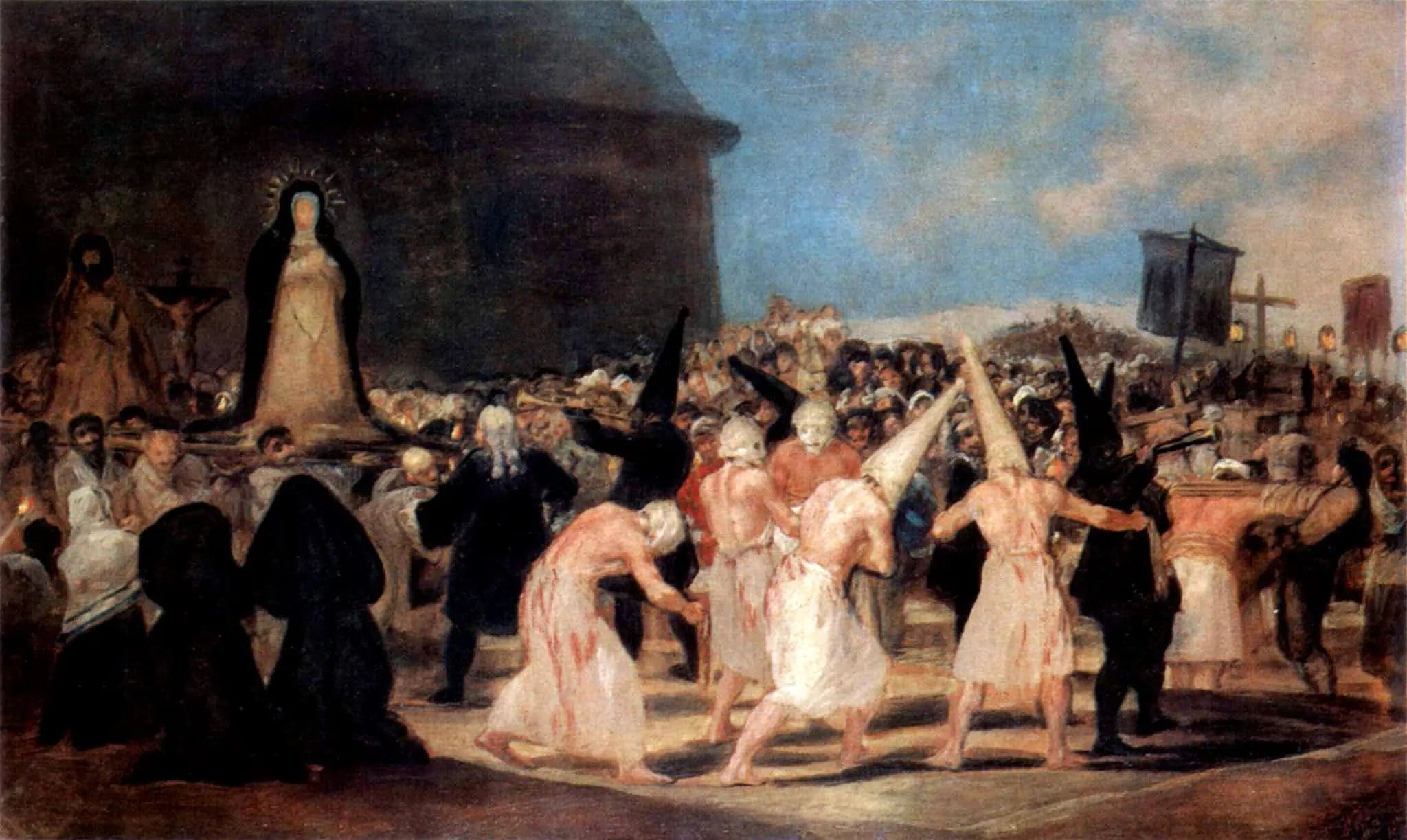
Procession of Flagellants
- Original dimensions
- 73 x 46 cm
- Museum
- Royal Academy of Fine Arts of Saint-Ferdinand
- Year
- 1812
Scene depicted
In this pictorial work, Francisco de Goya depicts a dark and mysterious procession, where flagellants move slowly, enveloped by an atmosphere of disturbed serenity. The scene, marked by suffering and penance, challenges the viewer on the human condition and the rituals that surround us.
Historical context
Created in 1812, in Madrid, this painting is emblematic of the romantic movement. The work unfolds at the heart of a time marked by social and political upheavals. Currently, the canvas is housed within the elitist Royal Academy of Fine Arts of Saint-Ferdinand, nestled in the vibrant Spanish capital. Its dimensions, 73 x 46 cm, enhance the power of this striking composition.
Place in the artist's career
This painting marks a milestone in Goya's career, signaling a period when his style matures and becomes distinctive. Alongside La Maja Desnudada and Los Fusilamientos del 3 de Mayo , this canvas reveals a strong emotional evolution and boldness in visual expression, marking his transition to more critical works.
Anecdote
“Art must reflect our soul, just as light illuminates darkness,” said Goya. That morning, in the alleys of Madrid, light was making its way through the veils of mist. It was this moment of fleeting clarity that inspired the artist for this masterpiece , a canvas that the world will never forget.