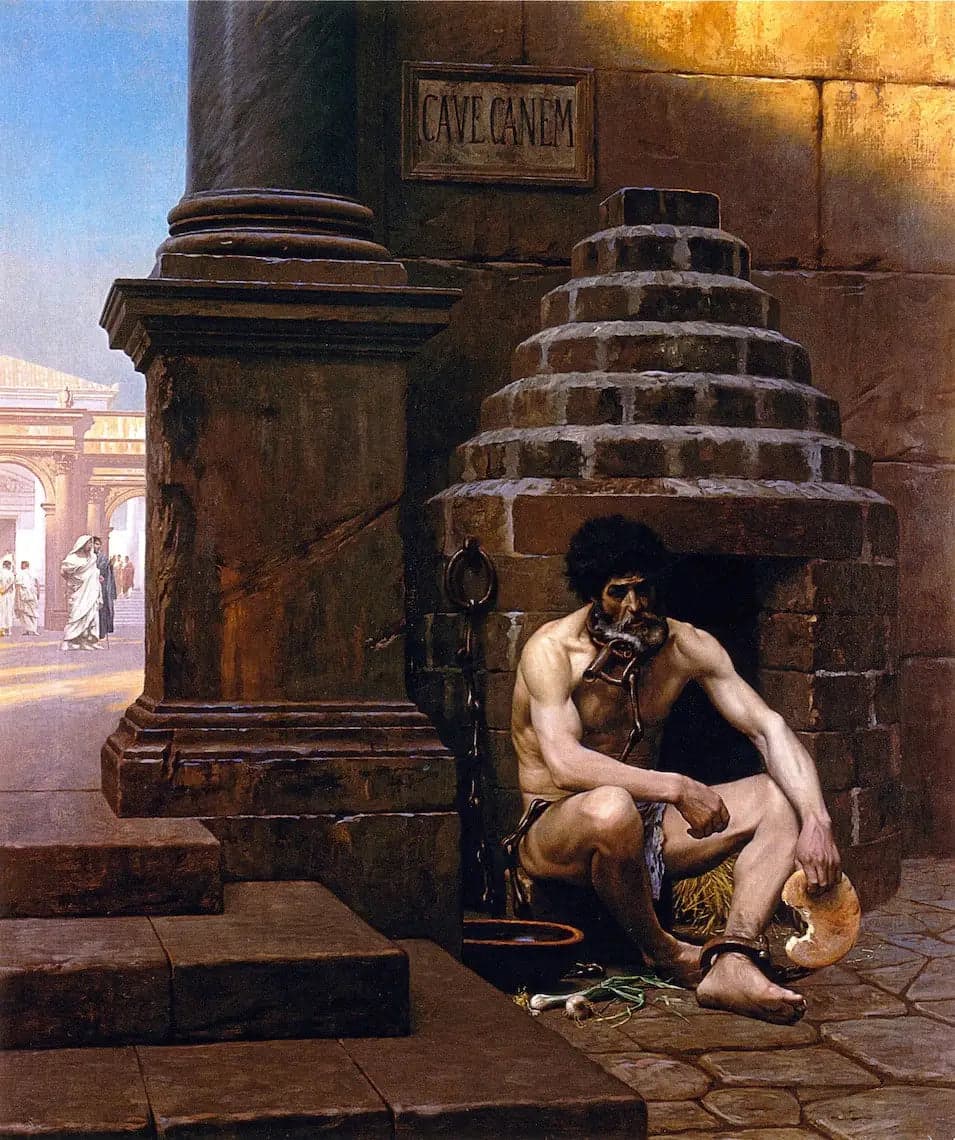
Prisoner of War in Rome - Jean
- Original dimensions
- 91 x 109 cm
- Museum
- museum Jean-Léon Gérôme
- Year
- 1881
Scene depicted
The canvas "Prisoner of War in Rome" illustrates a particularly striking scene: a Roman soldier, surrounded by captives, evokes not only the suffering of one man but also that of many peoples throughout history. With his gaze anchored in the distance, the character seems lost in a world of reflections, thus offering a poignant perspective on the notion of captivity. Gérôme succeeds in capturing this tension between oppression and inner freedom, evoking a universal humanity in sulfur.
Historical context
Created in 1881, the painting "Prisoner of War in Rome" finds its roots in a rich and complex context, at the crossroads of Orientalism and realism . At that time, Jean-Léon Gérôme , an emblematic figure of this movement, settled in Paris, offering the world a timeless vision of his subjects, often inspired by distant travels. This canvas , currently exhibited at the Jean-Léon Gérôme museum, reflects a time when Art served as a reflection on the human condition, while revealing profound social dimensions. Its impressive dimensions of 91 x 109 cm invite the viewer to a total immersion in this poignant scene.
Place in the artist's career
The canvas "Prisoner of War in Rome" stands as a pinnacle in Gérôme's career, marking a period of great artistic maturity. This masterpiece, alongside other iconic works like "The Gladiators" or "The Fairy Carabosse," depicts a subtle stylistic transition, where the mastery of realism merges with more liberated compositions, while maintaining a captivating psychological depth.
Anecdote
“Each masterpiece is a fragment of my soul.” This quote from Gérôme resonates even more when evoking the genesis of his flagship canvas . Perhaps it was on a gentle morning, under the light of a Parisian spring, that the artist found inspiration. The idea of a man, captive, absorbed in his thoughts, came to him as he wandered through the ancient streets of a timeless Rome. It is this emotion, this vertigo of memory that pulses through each brushstroke, forging his emblematic painting .