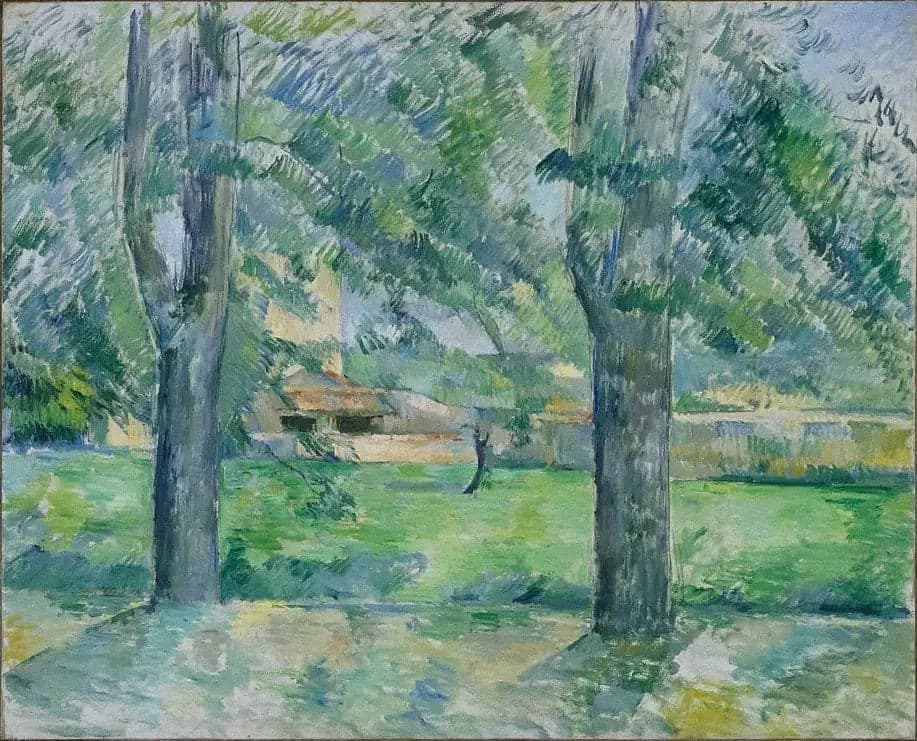
Prairie and Farm of Jas de Bouffan
- Original dimensions
- 81.5 x 66 cm
- Museum
- National Gallery of Canada
- Year
- 1886
Scene depicted
This painting offers an idyllic vision of the Provençal countryside. Through a harmonious composition, Cézanne depicts a meadow adorned with a rustic farm, a symbol of tranquility and beauty, where humanity and nature coexist in a delicate dance. The vibrant colors blend to create an almost palpable atmosphere, inviting the viewer to explore the details of this canvas .
Historical context
Created in 1886, this iconic painting finds its roots in Aix-en-Provence, where Cézanne, an emblematic figure of post-impressionism , began to explore forms and colors in an unprecedented way. Meadow and Farm of Jas de Bouffan is part of the artistic movement that redefined the pictorial landscape of the late 19th century. Today, this painting is housed in the National Gallery of Canada , testament to its lasting legacy.
Place in the artist's career
Situated at a turning point in his career, Meadow and Farm of Jas de Bouffan reveals Cézanne's genius in combining tradition and modernity. Alongside works such as Mont Sainte-Victoire and The Large Bathers , this painting illustrates the maturity of his style, as he turns away from academic norms to explore a new dimension of artistic expression.
Anecdote
“Nature is my true muse, it guides me with every brushstroke.” These words resonate as a key to understanding this masterpiece . Imagine Cézanne, on a spring morning, wandering through the fields of Jas de Bouffan, where the light caresses the earth and the leaves of the trees, inspiring his painting . Every shade of green, every cast shadow evokes the wonder he felt.