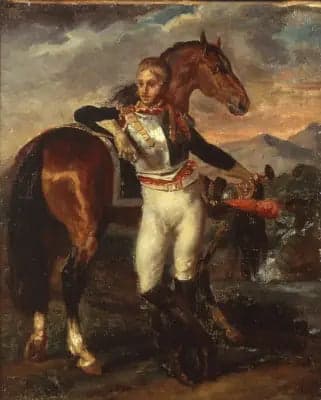
Posthumous Portrait of Lieutenant Legrand
- Original dimensions
- 37.5 x 45.5 cm
- Museum
- Museum of Modern Art of Saint-Étienne
- Year
- 1810
Scene depicted
The painting depicts a man with a serene gaze, a lieutenant fallen in battle. In this posthumous portrait, Géricault captures the dignity and sadness of a sealed fate, skillfully merging emotion and technique in a composition that still resonates today.
Historical context
Created in 1810, in Paris, during the height of the Romantic period, the painting "Posthumous Portrait of Lieutenant Legrand" is set against a rich historical backdrop, where France explores the intensity of human emotions. This iconic painting, now displayed at the Museum of Modern Art of Saint-Étienne, evokes both memory and sacrifice, a theme dear to the artist.
Place in the artist's career
“Posthumous Portrait of Lieutenant Legrand” sits at the crossroads of Géricault's promising beginnings. Nevertheless, it heralds equally significant works such as “ The Raft of the Medusa ” and “The Battle of Hernani,” reflecting a captivating evolution both emotionally and technically in his pictorial work.
Anecdote
“Every face tells a story, every brushstroke brings it to life,” Géricault might have declared while recalling the intensity of a spring morning in Paris. It is this precise moment, imbued with melancholy, that inspired him to immortalize a lost face, thus touching the very soul of the canvas .