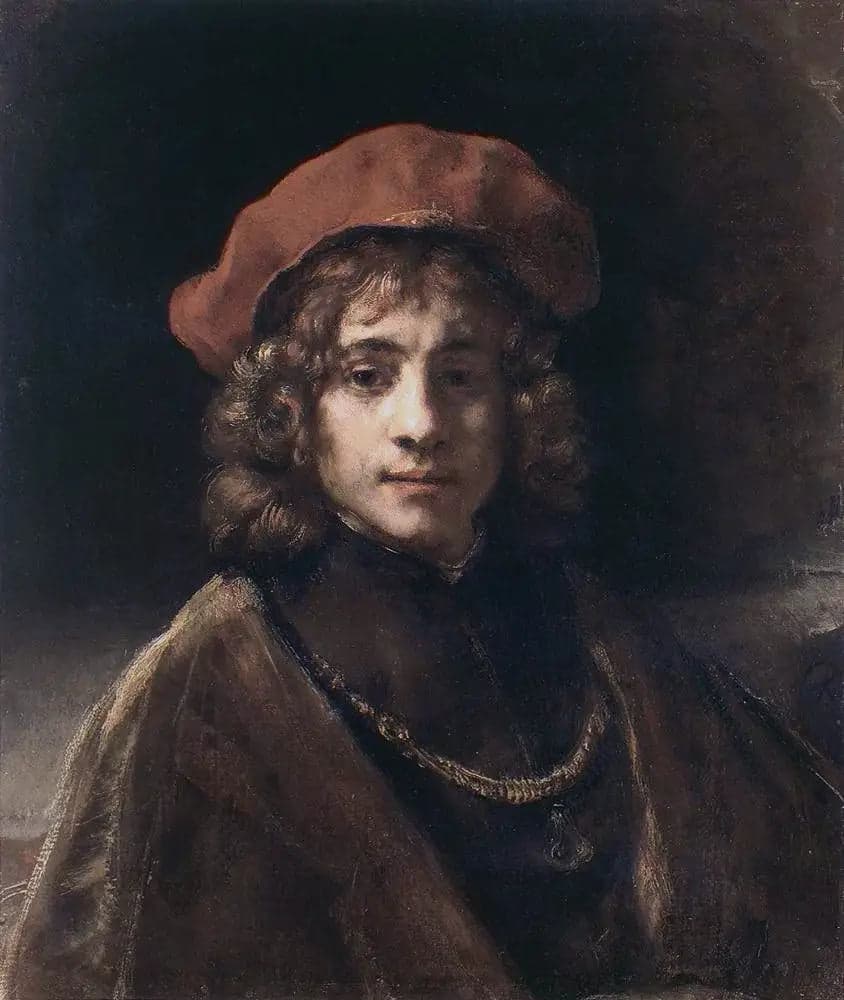
Portrait of Titus van Rijn
- Original dimensions
- 57.3 x 68.5 cm
- Museum
- Wallace Collection
- Year
- 1657
Scene depicted
This canvas illustrates a young boy, the artist's son, with a thoughtful and mysterious gaze. Marking the innocence and curiosity of a child, every nuance of the painting reveals a dichotomy between wisdom and innocence. The field of shadow and light surrounding his face exudes an almost mystical atmosphere, immersing the viewer in a world of personal reflections and deep sensations.
Historical context
This painting was created in 1657, in Amsterdam, an iconic city for the Dutch during the 17th century, a time marked by the Baroque and the creation of masterpieces in pictorial art. The canvas , now preserved at the Wallace Collection in London, captured the very essence of the artistic movement of the time, blending surgical precision and moving intimacy while playing with light and shadow, an essential characteristic of Rembrandt 's work.
Place in the artist's career
This masterpiece represents a turning point in Rembrandt 's career, coming after achievements such as the "Night Watch" and before more mature works like "The Anatomy Lesson of Dr. Tulp." This canvas is a testament to a style that evolves towards increased emotional sensitivity, reinforcing Rembrandt 's prominent role in the history of European art.
Anecdote
Rembrandt stated: "A portrait is the visual soul of a person, captured for eternity." This credo resonates particularly with the moment of the creation of the masterpiece , during a cool April morning in his studio. The face of Titus, imbued with a gentle melancholy, captured the master's imagination, revealing through this canvas the complexity and depth of the human soul.