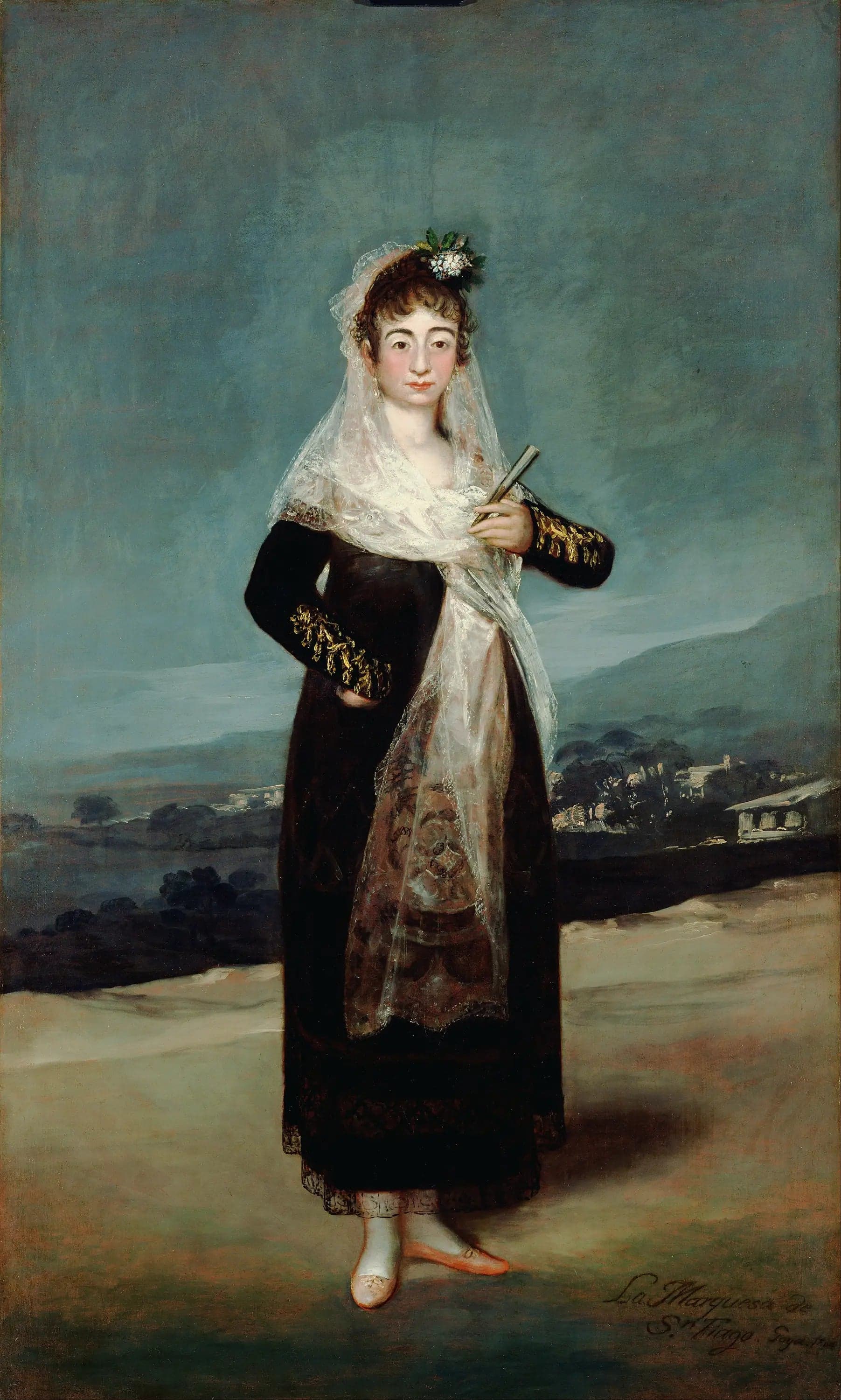
Portrait of the Marchioness of Santiago
- Original dimensions
- 1264 x 2096 cm
- Museum
- Getty Center
- Year
- 1804
Scene depicted
This captivating painting depicts the Marquise of Santiago in all her splendor, dressed in a sumptuous gown of vibrant colors that overwhelms the senses. The relaxed posture of the marquise, her gaze turned towards the horizon, evokes a natural elegance, blending nobility with subtle melancholy. Goya succeeded in capturing not only the appearance of a woman but also the very essence of her character, making the scene vibrant with life.
Historical context
Created in 1804, this painting is emblematic of the workshop of Francisco de Goya , located in Madrid, the cradle of the Enlightenment and artistic developments of the early 19th century. This canvas , depicting the Marquise of Santiago, echoes the rococo and neoclassical styles, reflecting the richness and contradictions of Spain at the time. Today, the painting resides at the Getty Center, a place where art and architecture meet in sublime harmony.
Place in the artist's career
The Portrait of the Marquise of Santiago represents a turning point in Goya's career. As he anticipated the revolutions to come both socially and artistically, this canvas perfectly illustrates his ability to combine personal introspection with phenomenal talent. Comparatively, the painting “La Maja desnuda” and “The Executions of May 3, 1808” reveal a stylistic evolution, marking the transition to a sharper social consciousness.
Anecdote
“Every portrait I paint is an open window to the soul of my subject.” Goya revealed this philosophy during the creation of his masterpiece , inspired by a chance encounter with a lady of striking beauty on sunny mornings in Madrid. This fleeting moment transformed into a timeless composition, imbued with grace and emotion.