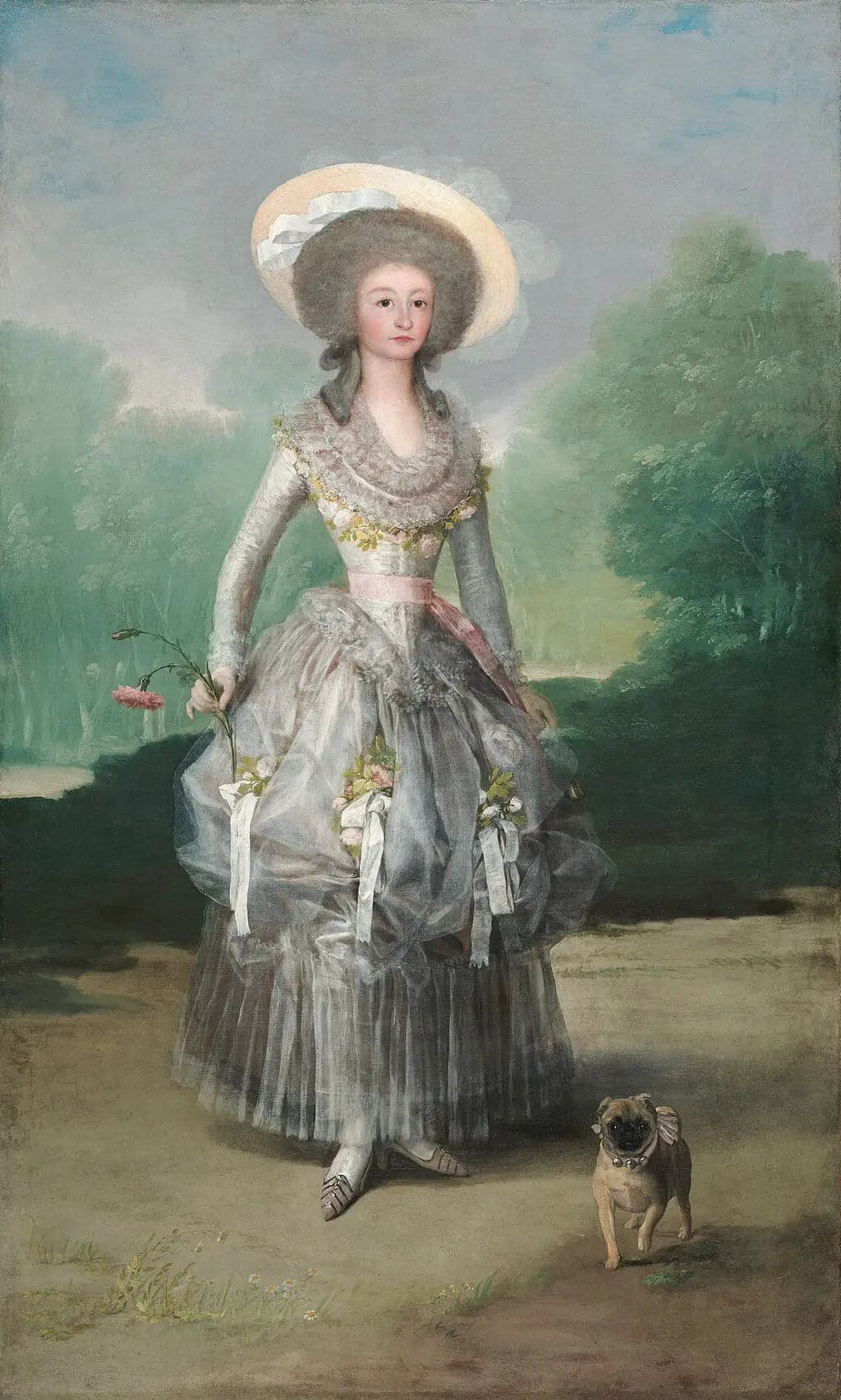
Portrait of the Marchioness of Pontejos
- Original dimensions
- 127 x 210.3 cm
- Museum
- National Gallery of Art
- Year
- 1786
Scene depicted
In the painting “Portrait of the Marchioness of Pontejos,” Goya immortalizes a Spanish noblewoman, capturing the fineness of her features and the richness of her clothing. The marchioness, illuminated by the benevolent light that highlights her face, embodies the grace and elegance of her time. The delicate composition draws the eye and invites admiration, while revealing the subtleties of her model's personality.
Historical context
Created in 1786, this painting is an iconic work of the Spanish master Francisco de Goya , set in the bright context of the Age of Enlightenment, in Madrid, Spain. Goya, a central figure of the romantic movement, offers here an intimate and elegant vision of the high society of the time. The canvas is currently carefully preserved at the National Gallery of Art, reflecting its cultural and artistic importance. Its impressive dimensions, 127 x 210.3 cm, add to its striking presence.
Place in the artist's career
The portrait of the Marchioness of Pontejos stands as a crucial milestone in Goya's career, marking his rise in the art world. This moment of artistic maturity is distinct from his earlier works, such as La Maja Desnuda and La Maja Vestida , where he already explores themes of sensuality and femininity, but with a more provocative lighting and depth.
Anecdote
Francisco de Goya once said: “Art is the mirror of the soul.” This quote resonates deeply in his masterpiece , whose creation was inspired by the brightness of a spring morning, when he met the marchioness in a blooming garden. This fleeting moment gave birth to a pictorial work that transcends time.