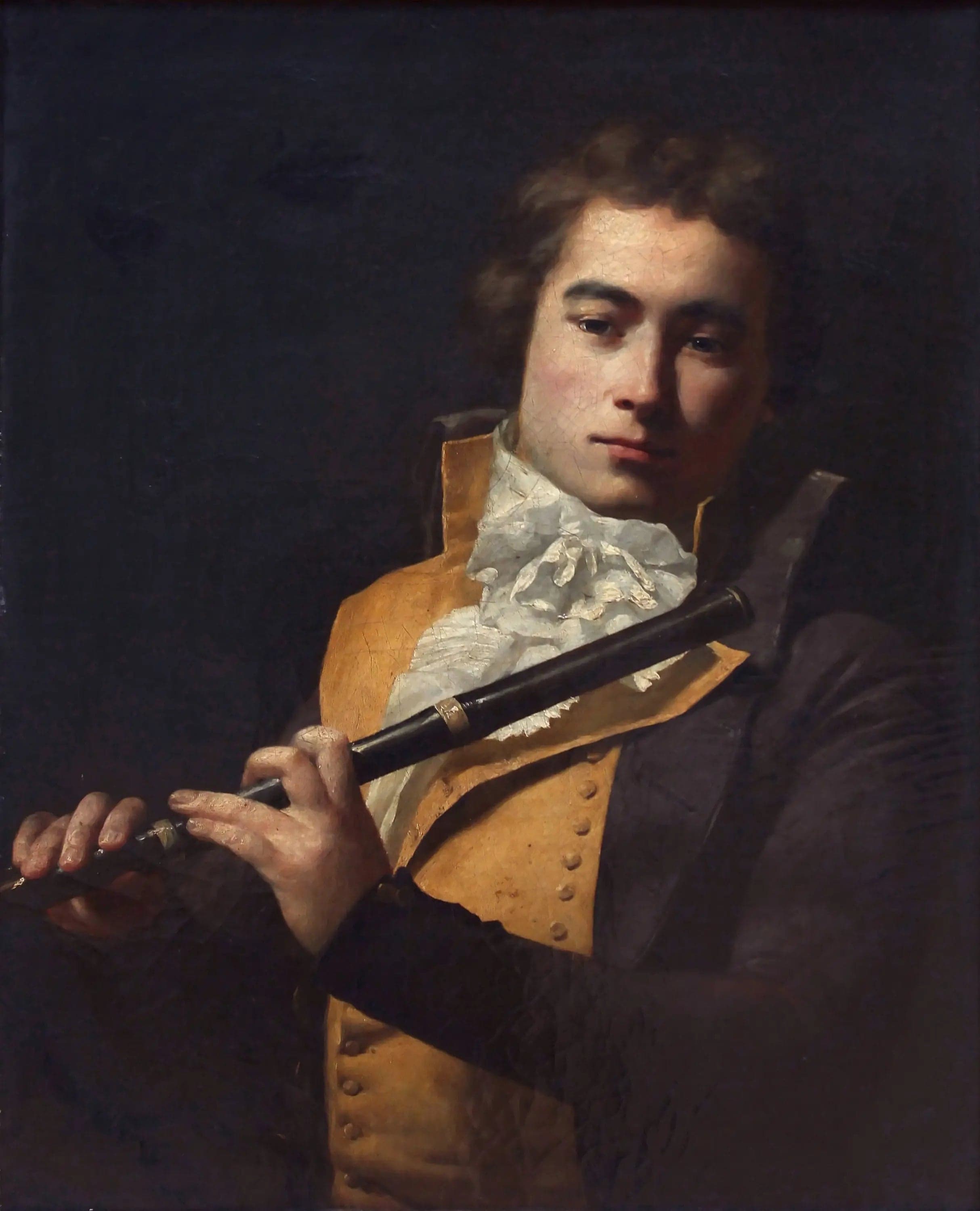
Portrait of the Flutist François Devienne - Jacques
- Original dimensions
- 59.5 x 75 cm
- Museum
- Royal Museums of Fine Arts of Belgium
- Year
- 1792
Scene depicted
In this masterpiece, the composition highlights the flutist François Devienne, fully mastering his art. Through his instrumentation, he embodies the refinement and musical virtuosity of his time. The piercing gaze and graceful posture of the flutist invite immersion into the sound universe, an invitation to listen to the sweet chords of a delicate melody. This painting symbolizes the union between visual and musical art, celebrating a time when Beethoven and Mozart emerged in the European musical landscape.
Historical context
Created in 1792, during the tumultuous period of the French Revolution, this iconic painting blends neoclassical art with a more personal and intimate approach. The canvas by Jacques-Louis David , depicting the flutist François Devienne, is now housed in the Royal Museums of Fine Arts of Belgium in Brussels, where it impresses with its size. David's work, a central figure of neoclassicism , fits into a time when art serves both as historical testimony and emotional escape.
Place in the artist's career
The Portrait of the Flutist François Devienne represents a pivotal moment in the career of Jacques-Louis David . This work comes just after his initial uncertainties and before his meteoric rise as one of the masters of neoclassicism . Compared to paintings such as " The Oath of the Horatii " or " Death of Marat ", this canvas reveals a more personal and intimate approach, showcasing his ability to capture light and the spirit of the individual beyond the striking heroism of previous compositions.
Anecdote
Jacques-Louis David once declared: "Art is the poetry of light and shadow." It was on a spring morning, in his studio bathed in soft daylight, that he envisioned this portrait. Upon meeting the expressive gaze of François Devienne, he felt a thrill of admiration. This emotion, vibrant and profound, resonates in the delicacy of the painting he executes, capturing not only the outward appearance but also the soul of his subject.