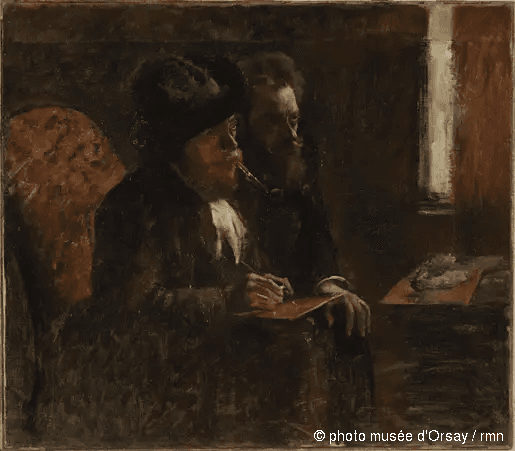
Portrait of the engraver Desboutin and the engraver Lepic
- Original dimensions
- 81 x 71 cm
- Museum
- Orsay Museum
- Year
- 1877
Scene depicted
This canvas represents two emblematic figures of graphic art, Desboutin and Lepic, immersed in their artisanal practice of engraving. The scene captured by Degas evokes the creative tension and concentration of the artists, revealing the intimacy of a moment shared between friends and art colleagues.
Historical context
Created in 1877, this painting is the result of a vibrant artistic climate in Paris, in the context of Impressionism , a movement that sought to capture light and movement. The canvas is now located at the Orsay Museum , thus testifying to the cultural and historical legacy of a time rich in artistic innovations.
Place in the artist's career
The Portrait of the engraver Desboutin and the engraver Lepic is sometimes considered a milestone in Edgar Degas 's career, symbolizing his artistic maturity. Through this canvas , one perceives the evolution of his style, especially when comparing it to works like “The Dance Class” and “Absinthe,” where he further explores the human figure and social interactions.
Anecdote
“I make myself the observer of the everyday, where beauty often hides in the ordinary.” Edgar Degas approached his masterpiece with a unique sensitivity, imagining the moment he saw his engraver friends in deep concentration, their features marked by the passion of work. This painting reflects that moment of artistic escape.