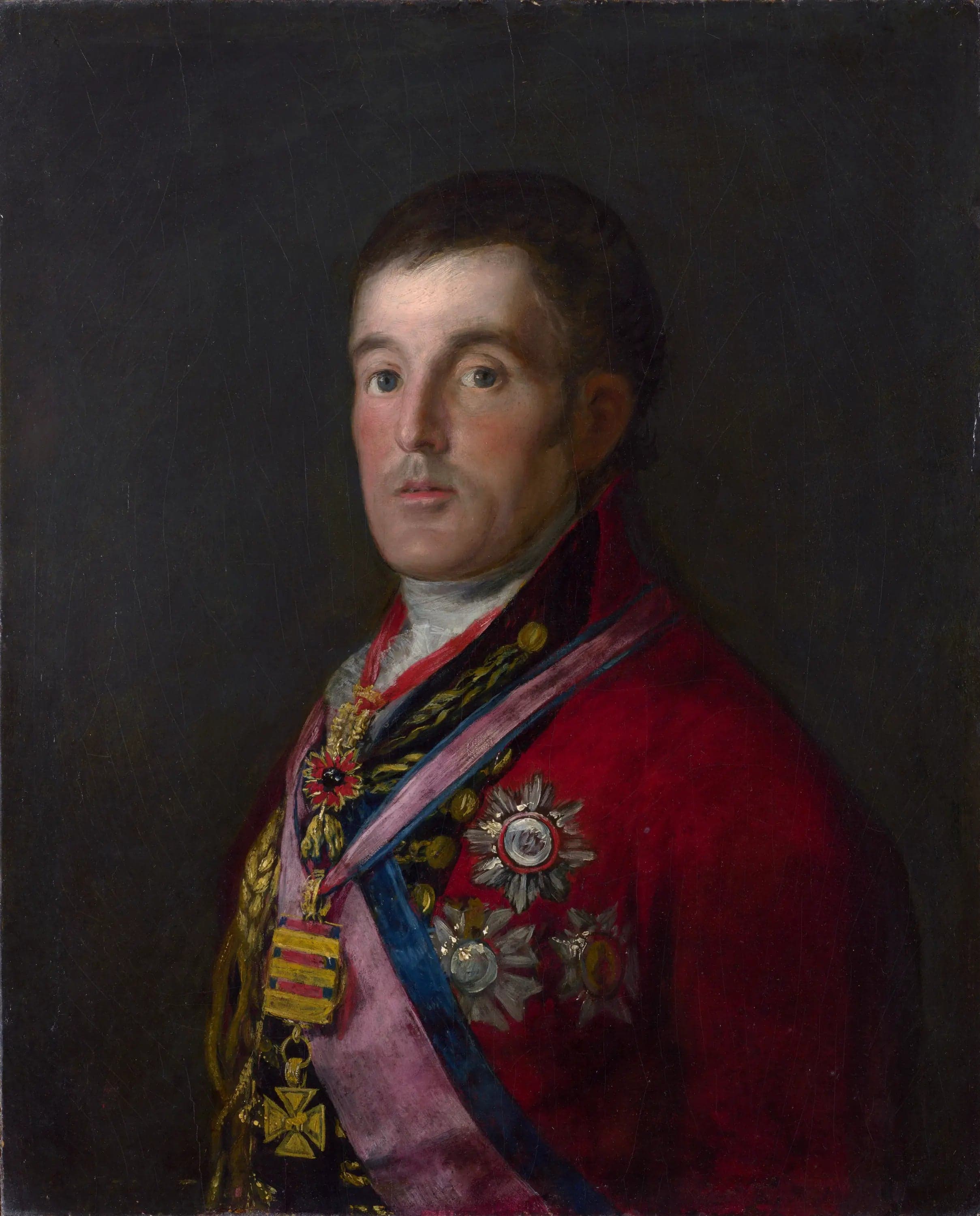
Portrait of the Duke of Wellington
- Original dimensions
- 52.4 x 64.3 cm
- Museum
- National Gallery
- Year
- 1812
Scene depicted
This painting reveals the face of the Duke of Wellington, an iconic military figure of his time. Illuminated by soft light, he stands tall and proud, dressed in his uniform. His posture, imbued with dignity and sobriety, suggests his crucial role in the history and politics of the time, a key moment for the United Kingdom and Europe. Goya, with his brush, captures not only the appearance but also the symbolic precedence of this historical figure.
Historical context
Created in 1812 in the vibrant city of London, this painting emblematic of Francisco de Goya is at the heart of Romanticism , a revolutionary artistic movement. The work finds its place in a context where political tensions echo personal aspirations, resonating with many stories of struggles and human triumphs. Today, the painting is carefully preserved at the National Gallery, where its historical and artistic significance is celebrated daily.
Place in the artist's career
This masterpiece marks a turning point in Goya's career, illustrating his transition from a rigid neoclassical style to more personal and emotional expressions. Alongside La Maja Desnuda and Les Fusillades du 3 Mai , this painting testifies to his artistic evolution, addressing themes of power and humanity with a more contemporary approach.
Anecdote
Francisco de Goya once stated: "Painting is the reflection of souls." It was on a calm morning, bathed in golden light, that the artist crossed paths with the Duke of Wellington, a remarkable encounter that inspired him to create this majestic painting . This canvas evokes not only the physical appearance but also the inner richness of its subject.