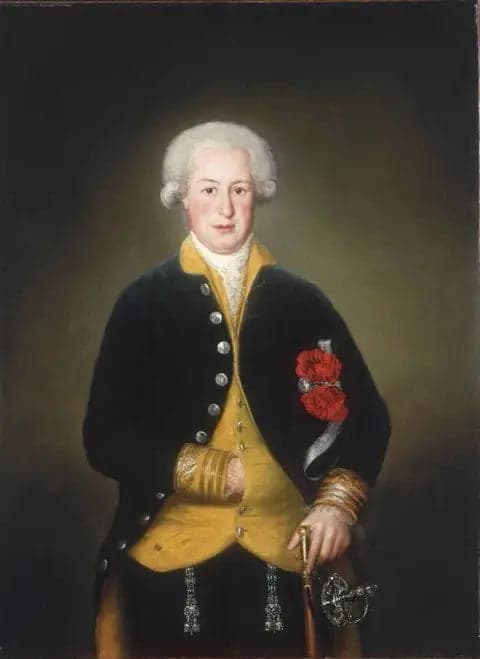
Portrait of the Duke of Osuna
- Original dimensions
- 82 x 118 cm
- Museum
- Not specified
- Year
- 1785
Scene depicted
The painting , a true mirror of its time, presents the Duke of Osuna in a noble posture, highlighting his charisma and stature. The work captures not only the aristocratic appearance of the character but also an atmosphere of power and finesse. The refined details, from the embroidery of his outfit to the sparkle of his jewelry, testify to Goya's skill in revealing the inner richness of his subjects.
Historical context
Created in 1785, the painting emblematic of Francisco de Goya is set against the royal and aristocratic context of Spain at that time. As the canons of the rococo movement crumble, Goya begins to assert his unique style, a blend of realism and emotion. This portrait painting is not only a faithful representation of the Duke of Osuna but also a poignant testimony to the manners and intrigues of the 18th-century Spanish court, now found in a private collection without museum specification.
Place in the artist's career
This painting marks the beginning of an already promising career for Goya, positioning the artist on the path to maturity. Compared to other works like “La Maja Desnuda” and “Saturn Devouring One of His Sons,” it signifies a transition to a more personal style, where realism intertwines with deep and sometimes troubling emotions.
Anecdote
In a moment of introspection in the heart of Madrid, Goya is said to have remarked: “Every face tells a story, and every canvas, a chapter of the human soul.” It was during a morning stroll that the artist crossed paths with the Duke, inspiring this vibrant masterpiece , full of nuances and depth.