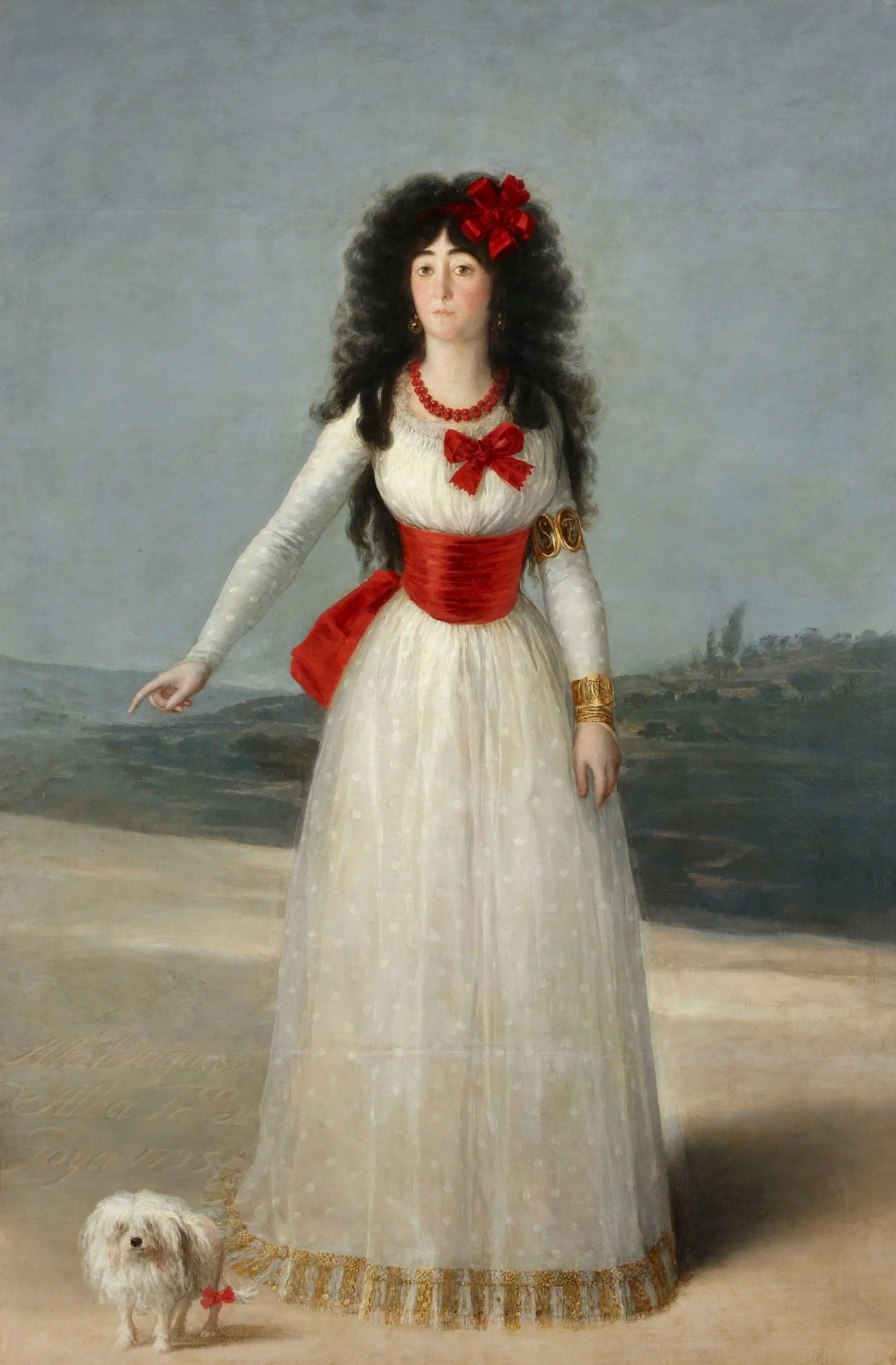
portrait of the Duchess of Alba
- Original dimensions
- 129 x 192 cm
- Museum
- Not specified
- Year
- 1795
Scene depicted
This iconic composition represents the Duchess of Alba, an aristocratic figure of great charisma. Her penetrating gaze seems to challenge the viewer, while the drapery of her dress folds gracefully around her. The play of shadows and lights, characteristic of Goya's style, infuses the scene with psychological depth. It is a confrontation between the present and the past, a suspended moment where every detail invites contemplation.
Historical context
Created in 1795, this painting was born in the bubbling context of Spain at the end of the 18th century. Made in Madrid, it is part of the romanticism movement that began to flourish. This canvas is a masterwork that reflects not only the aristocratic grandeur of the time but also the intimate relationship between Goya and his model, the Duchess of Alba. Currently, the painting is kept in a private collection, delighting art lovers.
Place in the artist's career
The portrait of the Duchess of Alba is situated at a decisive turning point in Goya's career. It is often considered one of his masterpieces, marking the peak of his personal style. Alongside paintings like “Las Meninas” and “The Family of Charles IV,” this painting illustrates his evolution towards a more introspective and emotional approach, highlighting both the power of his subject and his technical boldness.
Anecdote
Goya once said: “In every portrait, it is the soul of the model that I seek to capture.” This quote resonates with the painting of the Duchess of Alba, painted on a sunny morning, where the rays illuminated the room, highlighting the subtle sheen of the silk of her dress, like a caress of softness on this canvas .