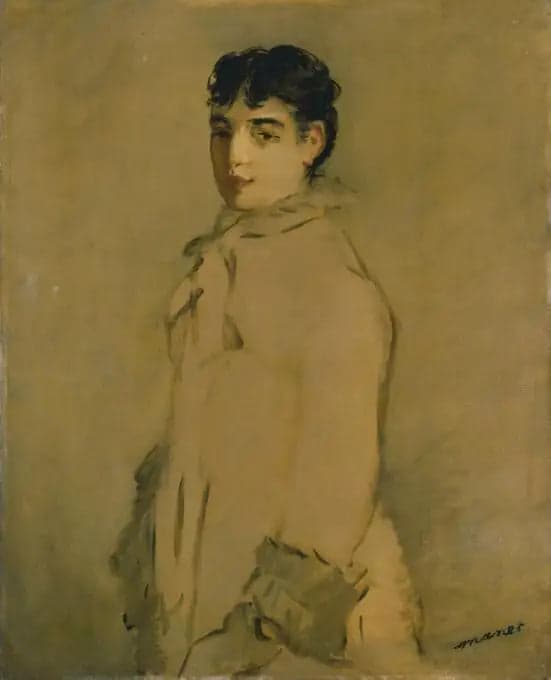
Portrait of the dancer Rosita Mauri
- Original dimensions
- 65 x 85 cm
- Museum
- Pushkin State Museum of Fine Arts
- Year
- 1879
Scene depicted
This canvas highlights Rosita Mauri, capturing the energy and grace of a dancer in full motion. Her vivid clothing and dynamic posture reveal Manet's skill in immortalizing the moment. The play of light and shadow emphasizes the fluidity of her silhouette and the intensity of emotion.
Historical context
Created in 1879, this painting was born in the vibrant setting of Paris, a city in full artistic effervescence, where the Impressionist movement begins to evolve. The canvas , now preserved at the Pushkin State Museum of Fine Arts in Moscow, embodies not only the pinnacle of realism but also the beginnings of a new aesthetic that transformed the art world.
Place in the artist's career
This Portrait of the Dancer Rosita Mauri marks a pivotal moment in Manet's career. At this time, the artist explores new paths, experimenting with light and composition. Alongside Olympia (1863), a masterpiece of provocation, and Le Déjeuner sur l’herbe (1863), he shows here a softness and sensitivity that are fully matured.
Anecdote
“Dance, like a light breath, embraces the body, and I wanted to capture that moment when everything becomes evanescent.” This quote could illustrate the inspiration of Édouard Manet , drawn during a cheerful morning at the Paris Opera, as he crosses the sparkling gaze of Rosita Mauri, a legendary dancer. The evocative power of the painting is thus magnified.