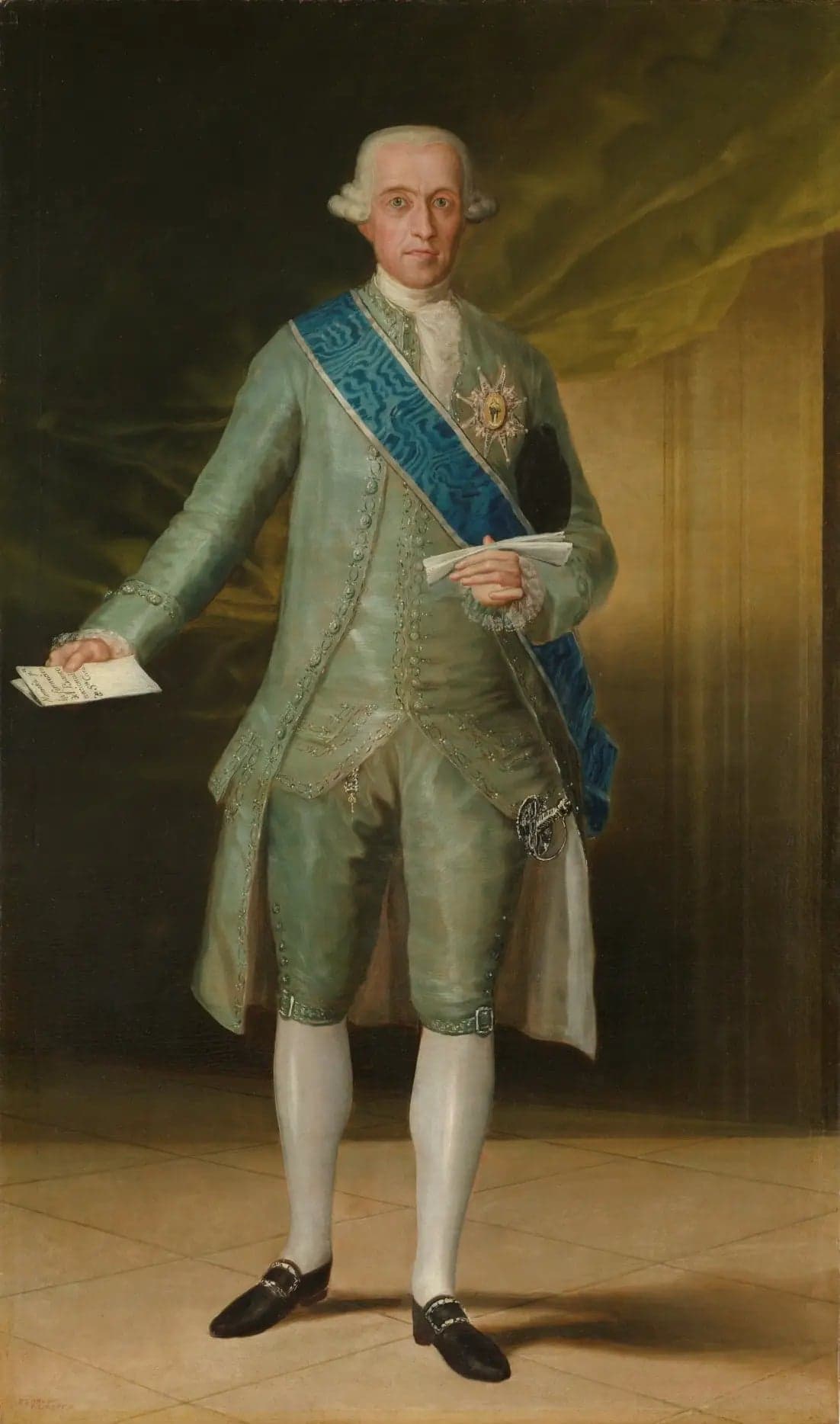
Portrait of the Count of Floridablanca
- Original dimensions
- 116.5 x 196 cm
- Museum
- Prado Museum
- Year
- 1783
Scene depicted
In this painting , Goya represents a portrait that is both official and intimate, where the Count stands in his elegant suit, surrounded by symbolic elements evoking his power. Every detail, from the draping of his cloak to the sparkle in his gaze, tells a story of dignity and responsibility. The work then becomes a mirror of the man in power, marrying both majesty and humanity.
Historical context
This painting is majestic, created in 1783 in Madrid, testifying to the intellectual effervescence of the Age of Enlightenment. Francisco de Goya , an emblematic figure of Spanish romanticism , captures here the Count of Floridablanca, a key man in the Spanish politics of the time. This pictorial work, preserved in the Prado Museum, is a pillar of European artistic heritage, measuring 116.5 x 196 cm, inviting a journey through time.
Place in the artist's career
Positioned at the heart of his career, this masterpiece illustrates Goya's genius at this pivotal moment. Compared to other compositions such as “La Maja Desnuda” or “The 3rd of May 1808,” this painting demonstrates the evolution of his style, between realism and romanticism , sealing his artistic legacy.
Anecdote
“The light that dances on faces reveals more than words,” said Goya as he sketched the contours of his thought. Inspired by the silence of a sunny morning, he finds in the Count's face a melody of colors that unfolds on the canvas . This emotion, palpable in the painting , reveals the depth of the man and his time.