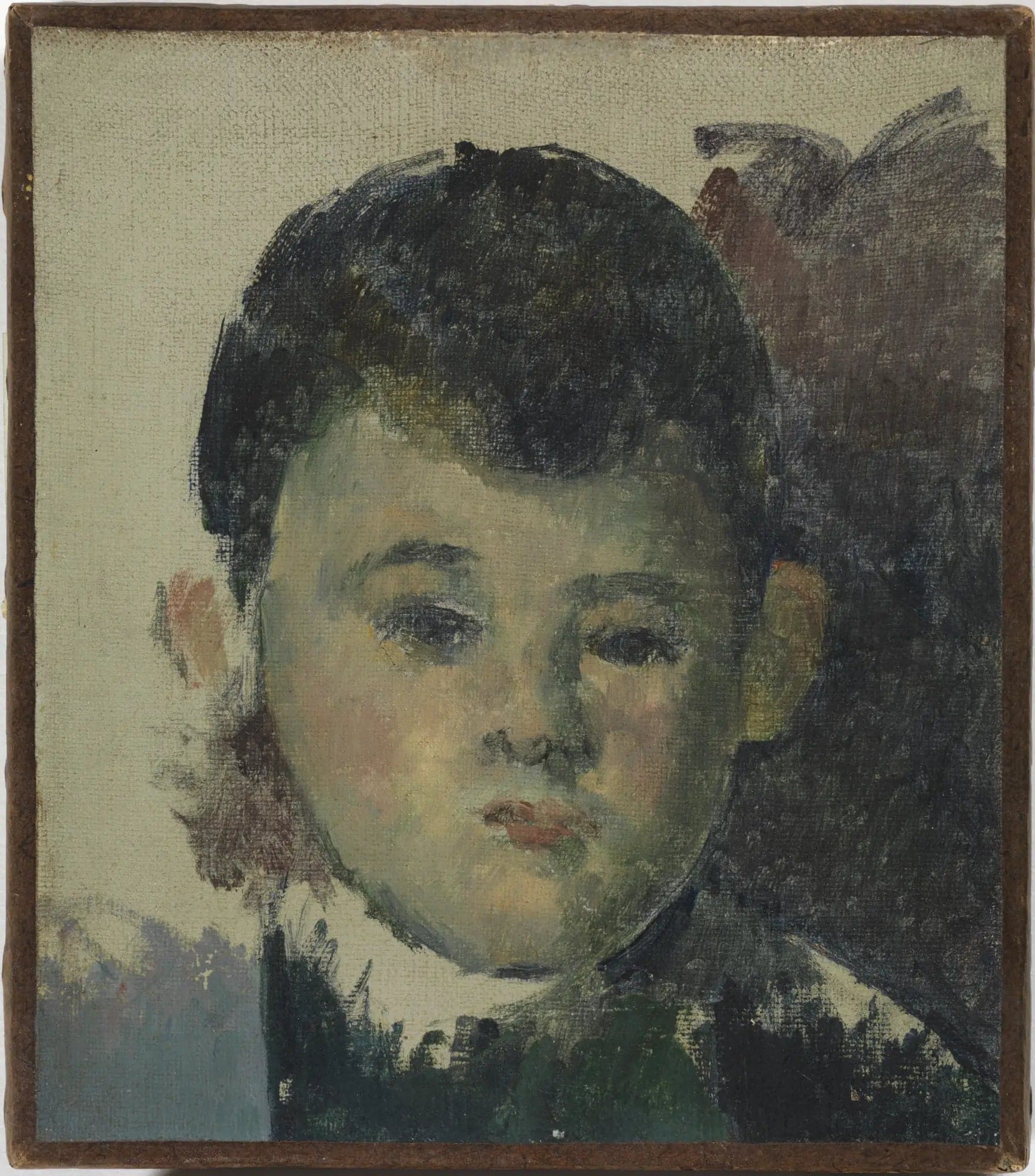
Portrait of the Artist's Son
- Original dimensions
- 15 x 17 cm
- Museum
- Princeton University Art Museum
- Year
- 1875
Scene depicted
In this eloquent canvas , the young boy, with his delicate and innocent features, embodies the spirit of a bygone era. Cézanne constructs an intimate composition, aiming to immortalize childhood. The simplicity of the scene, where the subject almost blends with the background, invites silent and touching contemplation.
Historical context
Created in 1875, in the heart of Aix-en-Provence, this painting summarizes the essence of the post-impressionist movement. In this intimate setting, Cézanne, a precursor of modern art, managed to capture childlike innocence. Currently exhibited at the Princeton University Art Museum , this canvas exudes a disturbing warmth and intimacy, measuring 15 x 17 cm.
Place in the artist's career
This canvas stands as a centerpiece in Cézanne's work, synonymous with his artistic evolution. At the moment he approaches abstraction, it can be compared to works like "La Montagne Sainte-Victoire" and "Les Joueurs de Cartes," which also testify to his quest for depth and light.
Anecdote
“Beauty lies in innocence,” Cézanne might have said, while painting this masterpiece surrounded by the gentle whispers of nature. Imagine a spring morning, light filtering through the branches, illuminating his son's face. This painting bears witness to filial love, revealing a unique emotional depth.