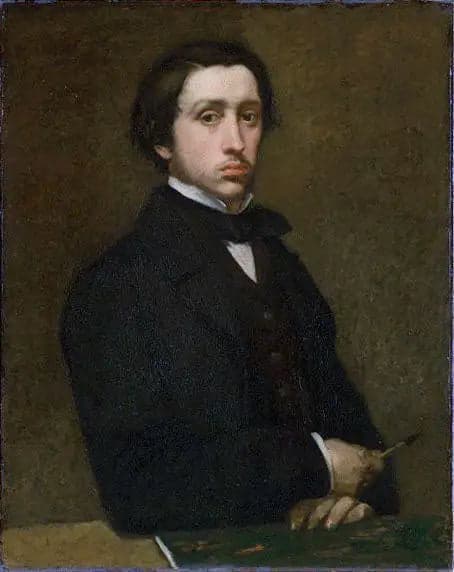
Portrait of the Artist
- Original dimensions
- 64.5 x 81.3 cm
- Museum
- Louvre Museum
- Year
- 1854
Scene depicted
This painting reveals the very essence of its creator, capturing his thoughtful silhouette, deeply absorbed in his artistic reflections. The composition unveils a rare intimacy, filled with delicate nuances, where each brushstroke draws us into Degas's introspective universe. This is not just a simple self-portrait, but a true artistic introspection of his journey.
Historical context
Created in 1854, the painting “Portrait of the Artist” by Edgar Degas is set in the vibrant context of 1850s Paris. This iconic painting, located at the Louvre Museum in Paris, is part of the Impressionist movement, although Degas's technique and approach are unique, marking a transition to striking modernity.
Place in the artist's career
Considered one of the milestones of his career, this painting illustrates Degas's evolution as an artist. Alongside his famous painting “Dancers at the Barre” and the painting “The Bellelli Family,” this masterpiece reveals his exploration of forms and lights, making him a pioneer of the Impressionist movement.
Anecdote
Edgar Degas once said: “The artist must be a little of everything, but first, he is an observer.” It is in this sincere desire to observe the world that the artist found inspiration for his masterpiece . Imagine him in the early morning, the subtle scent of coffee floating in the air, seeking the perfect light that caresses his face and that of his subjects.