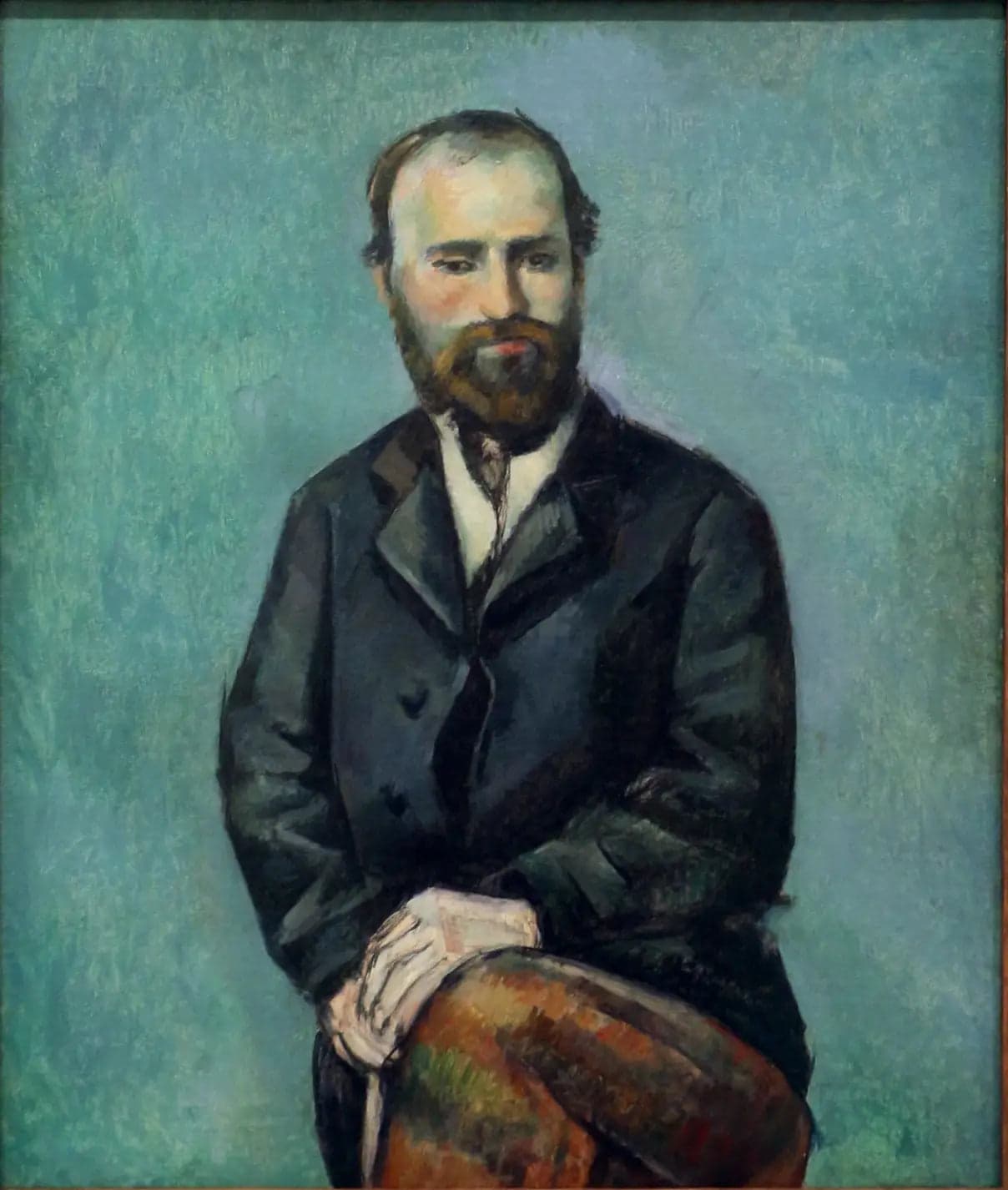
Portrait of the artist, after a photograph
- Original dimensions
- 65.09 x 73.98 cm
- Museum
- Carnegie Museum of Art
- Year
- 1885
Scene depicted
In this work, the artist's penetrating gaze is frozen, offering a reflection on the duality between the artist and his art. Cézanne himself, in search of harmony between technical expertise and emotional expression, reveals himself in a melancholic pose, evoking a silent dialogue with his surroundings through the simplicity and depth of his painting .
Historical context
Created in 1885 in the city of Aix-en-Provence, this painting is emblematic of the post-impressionist movement. At that time, Cézanne explored new dimensions of perception, seeking to transport onto canvas the reality that his eyes perceive. Currently, the painting resides at the Carnegie Museum of Art , a sanctuary testifying to American cultural heritage.
Place in the artist's career
This masterpiece is situated at a decisive crossroads in Cézanne's career, where he begins to assert his unique style. Alongside works such as “The Card Players” and “Mont Sainte-Victoire,” he illustrates the evolution of an emerging artist towards stylistic maturity, marking a turning point in the history of painting .
Anecdote
“Nature speaks to me at every moment, and it is in these silences that I find inspiration for my works.” These words resonate deeply, evoking the moment when Cézanne, immersed in a gentle southern light, decided to capture his own portrait, thus translating his inner essence through painting .