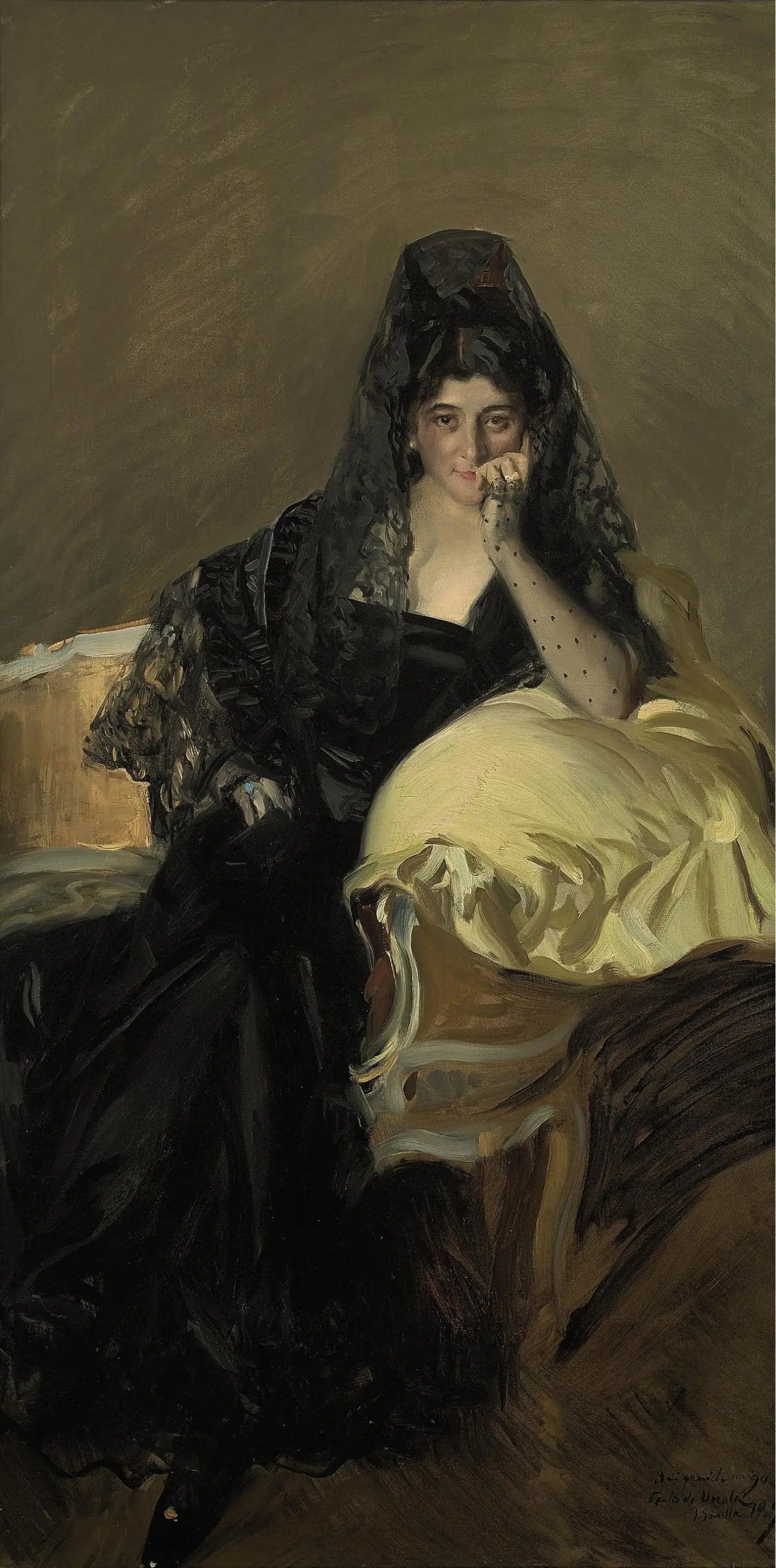
Portrait of Señora de Urcola wearing a black mantilla
- Original dimensions
- 85 x 185 cm
- Museum
- Not specified
- Year
- 1909
Scene depicted
This striking painting captures the depth and grace of a noble woman, veiled in a black mantilla, whose face seems to express both mystery and serenity. In a subtle dialogue between light and shadow, the painter succeeds in revealing the soul of her sitter, elevating this pictorial work to the status of an icon, reflecting the Andalusian character marked by both history and the cultural identity of the time.
Historical context
Created in 1909, the painting "Portrait of Señora de Urcola wearing a black mantilla" is set against the vibrant backdrop of the city of Valencia, Spain, at a time when the Impressionist movement, of which Joaquín Sorolla is one of the emblematic representatives, resonates with unparalleled intensity. This iconic masterpiece illustrates not only the refined technique of the artist but also the essence of a Spain in full transformation, imbued with traditions and artistic innovations. The work is currently unreferenced in a museum, but its impressive dimensions of 85 x 185 cm make it a painting with a strong presence.
Place in the artist's career
The Portrait of Señora de Urcola represents a pivotal moment in the career of Joaquín Sorolla . This painting, following his previous works such as "The Return of the Fishing" and "The Beach of Valencia," testifies to a growing mastery of light and emotions, marking an undeniable evolution towards an artistic maturity imbued with sensitivity.
Anecdote
"Light is the very essence of painting; it reveals the secrets of the world." Thus spoke Sorolla, inspired by the golden light of a spring morning in Valencia, when he crossed paths with the fascinating gaze of Señora de Urcola. This fleeting encounter became the opportunity to immortalize a silent elegance, perfectly embodying the emotion that emanates from this remarkable painting.