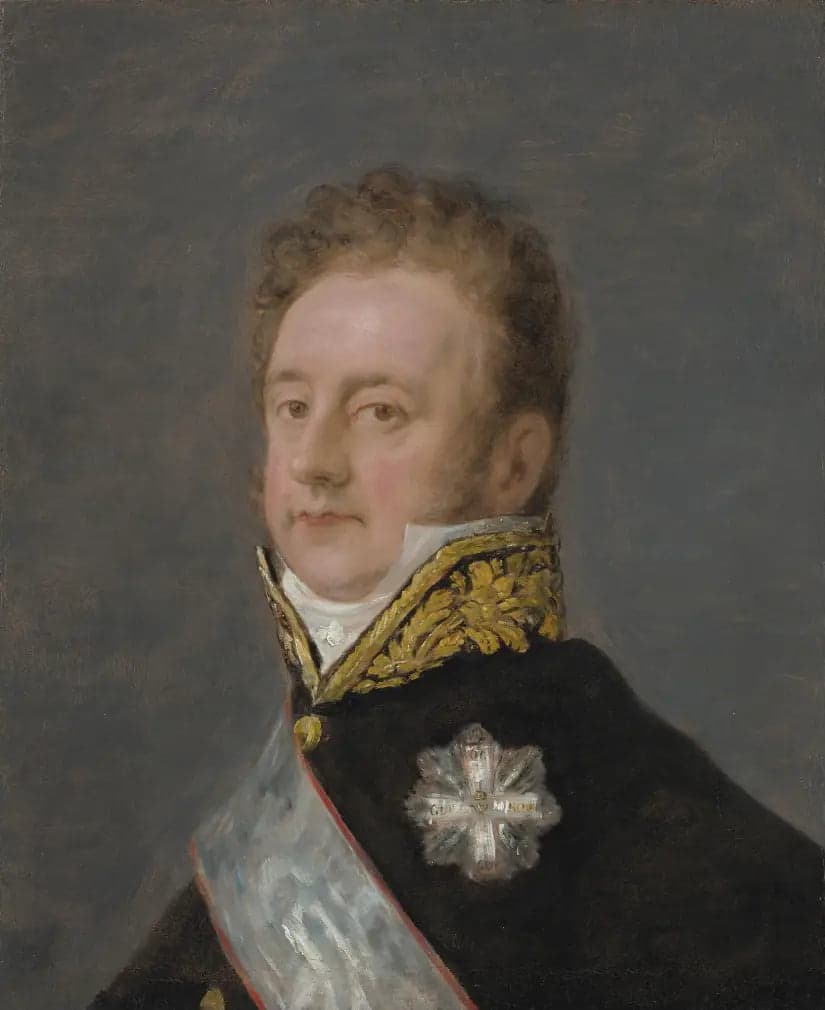
Portrait of Prince Aloys Wenzel von Kaunitz-Rietberg
- Original dimensions
- 48 x 59 cm
- Museum
- Not specified
- Year
- 1816
Scene depicted
This masterpiece illustrates Prince Aloys Wenzel von Kaunitz-Rietberg, a charismatic figure immersed in an atmosphere of aristocratic renewal. The work unfolds in a noble ambiance, where every detail of the costume and expression reveals a complex story, that of a man at the crossroads of tradition and progress, and of a portrait that transcends time.
Historical context
Created in 1816, this painting emblematic of Francisco de Goya leads the gaze into a Europe in full transformation. Crossing the shadows of war and the brightness of the Enlightenment, this canvas is set against the historical backdrop of social and political revolutions, precisely in Madrid, the vibrant heart of Spain. Although its current location is unknown, its imposing dimension of 48 x 59 cm continues to captivate with its grandeur.
Place in the artist's career
The painting is at the heart of an artistic quest, marking Goya's period of maturity, where emotion and technique harmonize. Alongside his other works such as “The Maja” and “The 2nd of May 1808,” this painting demonstrates the evolution of his style towards greater introspection and refined craftsmanship.
Anecdote
“Light is the voice of the soul,” Goya is said to have remarked, inspired by a bright morning where the sun's rays danced along the corridors of the court. It is in this vibrant atmosphere that the idea of capturing Prince Aloys Wenzel von Kaunitz-Rietberg, with his presence and mystery, was born. The painting thus arises from a dialogue between the artist and the light, transforming each brushstroke into a symphony of sensations.