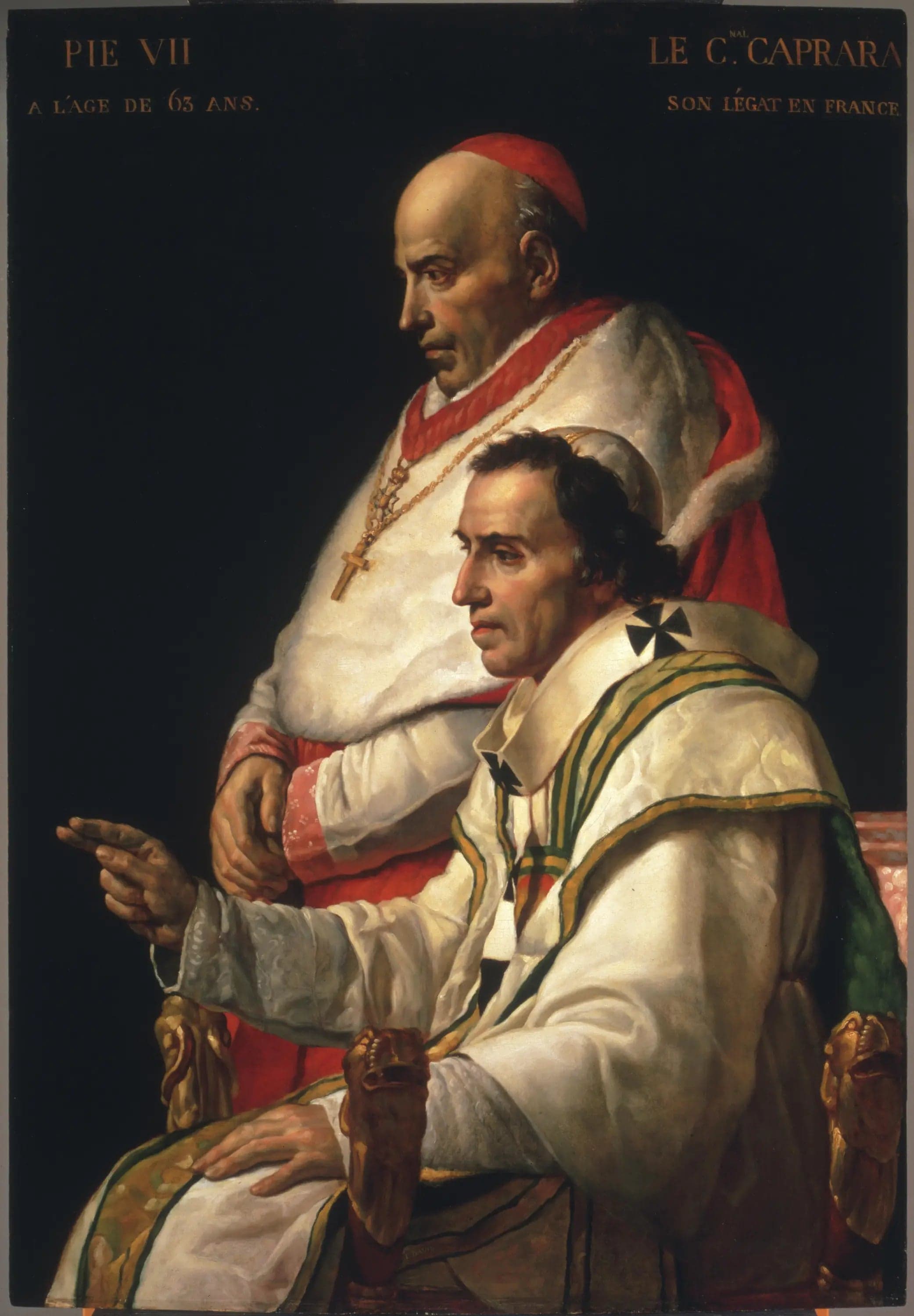
Portrait of Pope Pius VII and Cardinal Caprara - Jacques
- Original dimensions
- 96 x 138.1 cm
- Museum
- Philadelphia Museum of Art
- Year
- 1805
Scene depicted
The painting highlights Pope Pius VII, surrounded by Cardinal Caprara, capturing the essence of their relationship and the weight of spiritual responsibility. The expressions etched on their faces evoke the solemnity of their meeting, resonating with a narrative depth that transcends the simple portrait. It is a representation that heralds the graceful balance between religious power and the political stakes of their time, illustrating the chasm of human emotions through a striking composition .
Historical context
Created in 1805, this painting , emblematic of neoclassicism , comes from the workshops of Jacques-Louis David , one of the leading representatives of this artistic movement. Made in Rome, at the heart of Italy, during a time of political and social upheaval, this canvas bears witness to an era marked by power struggles and the dramatic changes of the Napoleonic era. Currently, the painting majestically resides at the Philadelphia Museum of Art , where it fascinates visitors with its impressive dimensions of 96 x 138.1 cm.
Place in the artist's career
This pictorial work represents a significant milestone in the career of Jacques-Louis David , testifying to his meteoric rise in the art world. It follows other symbolic paintings such as " The Oath of the Horatii " and precedes the famous " The Coronation of Napoleon ", marking a stylistic turning point where the rigor and precision of technique harmonize with the expression of emotions and political ideals of his time.
Anecdote
“Light belongs to those who dare to capture it,” David might have whispered one spring morning, as he drew inspiration from a meeting with an old friend, filled with memories and intertwined stories. In the creation of this masterpiece , each brushstroke becomes a silent prayer, an attempt to freeze a moment where power and faith intertwine in the magic of the visual harmony of the painting .