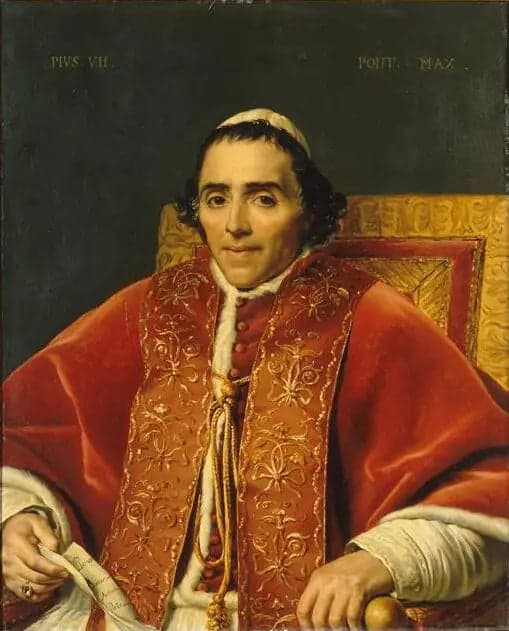
Portrait of Pius VII - Jacques
- Original dimensions
- 72 x 88 cm
- Movement
- Neoclassical painting
- Museum
- National Museum of the Château de Fontainebleau
- Year
- 1805
Scene depicted
In this canvas , Jacques-Louis David elevates the image of Pope Pius VII, embodying a spiritual power at the heart of a tumultuous period. The portrait reveals the pope in a contemplative posture, surrounded by symbolic drapery, evoking his majesty and authority. This pictorial work does much more than represent a religious figure; it captures the essence of a time when faith and politics were inextricably linked.
Historical context
Created in 1805 in Paris, during the neoclassical period, the painting "Portrait of Pius VII" by Jacques-Louis David is a testament to an era marked by political and cultural upheaval. This prestigious canvas , displayed at the National Museum of the Château de Fontainebleau, reflects the importance of Pope Pius VII at that time, while showcasing the development of the neoclassical style that advocated clarity of forms and harmony of colors.
Place in the artist's career
The painting "Portrait of Pius VII" marks a significant turning point in the career of Jacques-Louis David . Following iconic works such as " The Oath of the Horatii " and " The Death of Socrates ", this masterpiece symbolizes a stylistic maturity and a commitment to history and portraiture. It heralds a deepening of his themes on sacrifice and heroism, while highlighting a palpable humanity.
Anecdote
“Every brushstroke must breathe passion, every face must express a soul.” This inspired quote from David could well capture the essence of the inspiration that led him to create the masterpiece that is the painting "Portrait of Pius VII". Imagine a sunny morning in Rome, where twilight mingled with the golden light of the hills, as the artist meets the noble gaze of the pope, forever transforming his creative world.