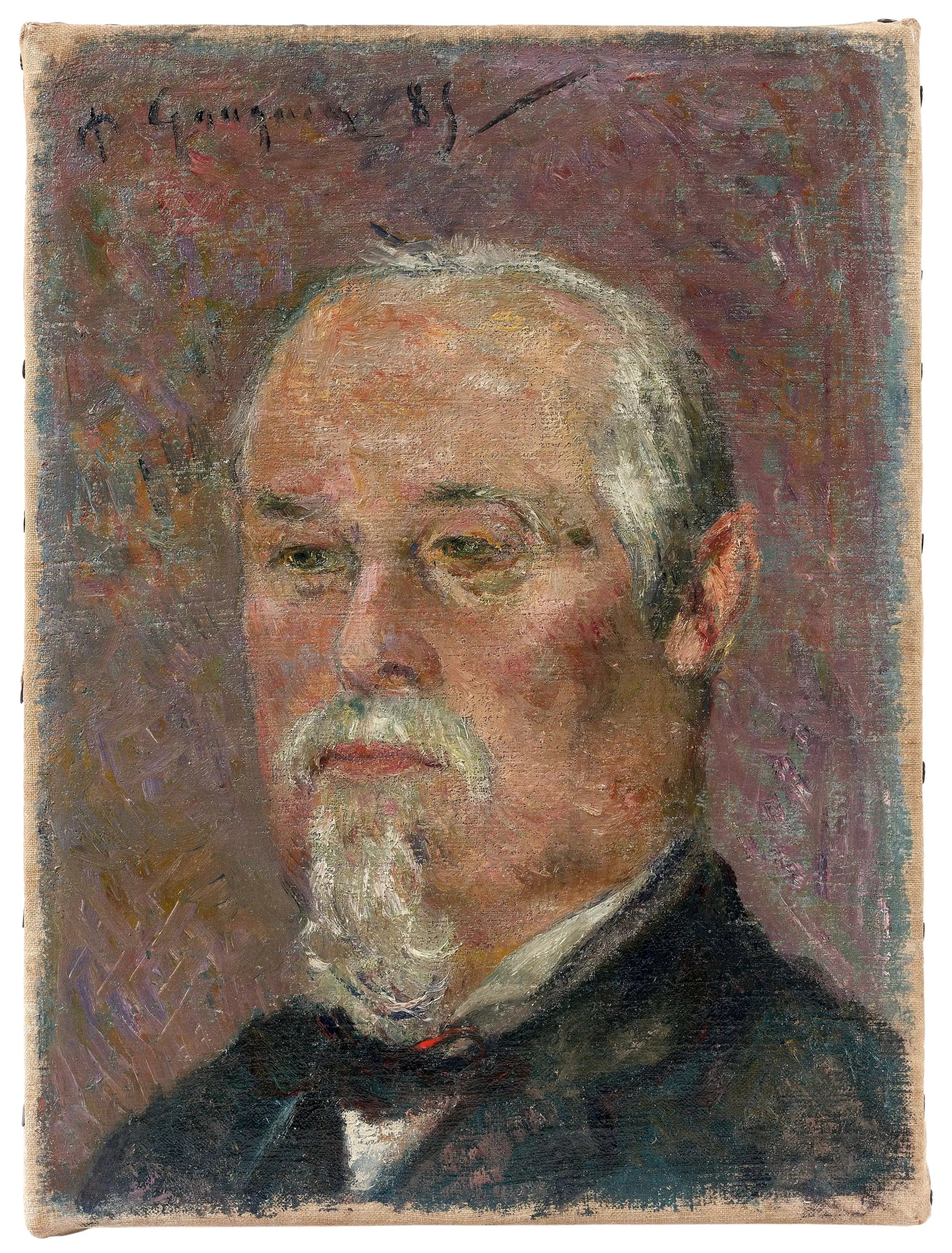
Portrait of Philibert Favre
- Original dimensions
- 24.5 x 32.5 cm
- Museum
- Not specified
- Year
- 1885
Scene depicted
The painting “Portrait de Philibert Favre” depicts with great depth the intimacy and personality of the subject. The figure of Favre, with an intrigued gaze, stands out against a soft background, revealing not only his face but also the very soul that inhabits him. Gauguin plays with light and shadows, creating a living portrait, vibrant with emotions and complexity.
Historical context
Created in Paris in 1885, this painting is situated at the edge of the post-impressionist movement. In a changing France, Paul Gauguin begins to forge a unique style where color and form free themselves from realistic constraints. The painting evokes the intensity of feelings and the subjectivity of perceptions, characteristics of an era in search of authenticity. Currently, the painting remains unavailable in public institutions, a testament to the rarity and value of this artwork .
Place in the artist's career
This painting is situated at a turning point in Gauguin's career, as he explores the boundaries between realism and expressionism . At the same time, works like “Vision after the Sermon” and “La Belle Angèle” show his evolution towards increased stylization. “Portrait de Philibert Favre” thus represents both a beginning and a promise, exposing a sensitivity that would later characterize his work.
Anecdote
“Art is a cry of the soul.” These words resonate as an echo to the conception of the masterpiece that is the Portrait de Philibert Favre. The artist, observing one April morning, captured the essence of a character, plunging his brush into a melody of colors, savoring each nuance like a musical note. It is in this breath of inspiration that this painting was born, capturing the quintessence of its model.