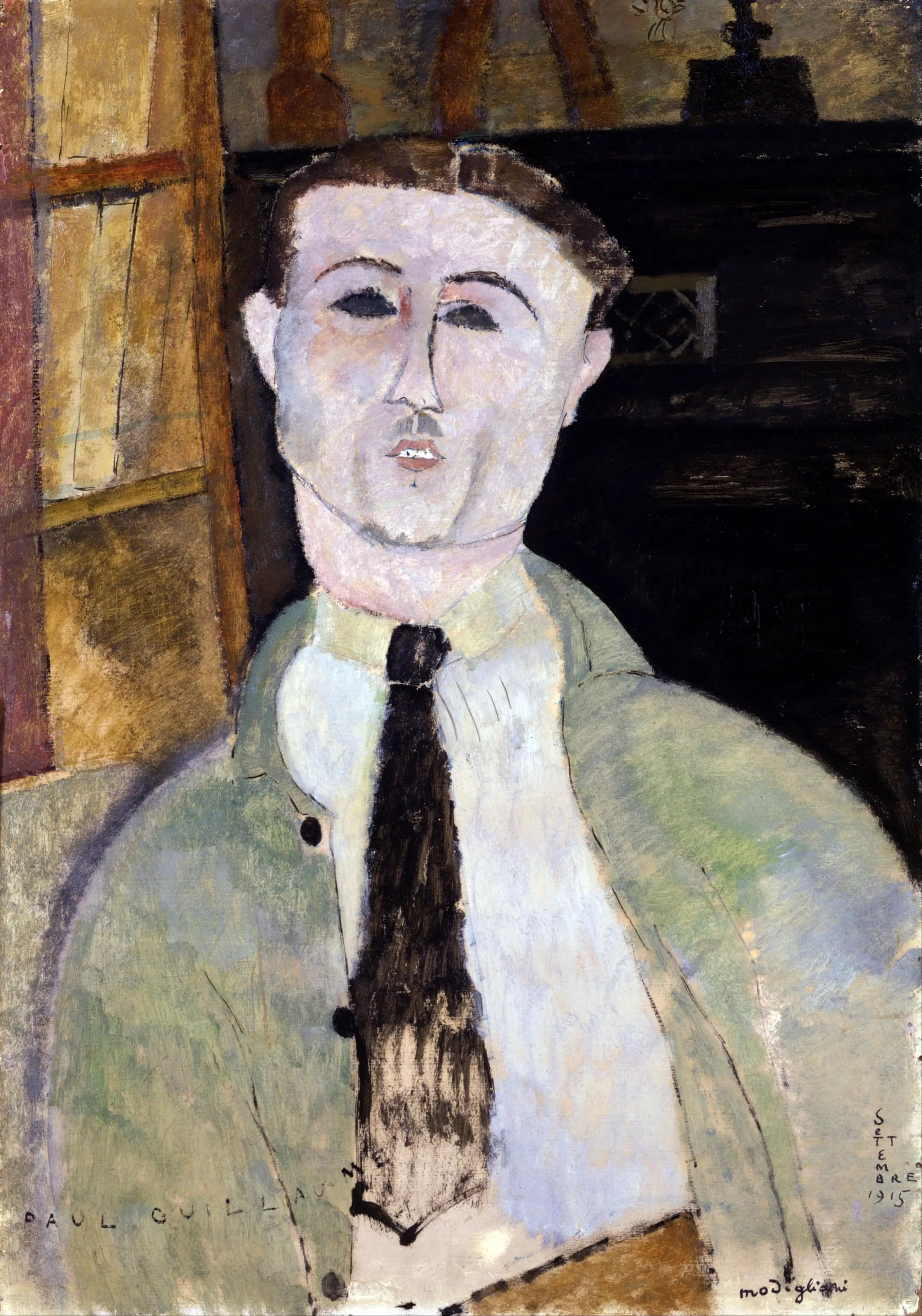
Portrait of Paul Guillaume
- Original dimensions
- 54 x 81 cm
- Museum
- Museo del Novecento
- Year
- 1916
Scene depicted
The painting shows a striking portrait of Paul Guillaume, an influential art dealer, whose introspective gaze and cherubic face reveal a duality between vulnerability and strength. Modigliani, with his ritualistic slowness, managed to render this profound humanity, creating a composition that speaks to the soul rather than the eye.
Historical context
Created in 1916, this canvas echoes a turbulent time, that of World War I. Located in Milan, this painting is part of the artistic movement of Modernism , reflecting a desire for renewal and deep introspection. Now exhibited at the Museo del Novecento, this tableau immerses us in a reflection on identity and human beauty through a unique prism.
Place in the artist's career
The portrait of Paul Guillaume represents a key milestone in Modigliani's career. Intimately linked to his unique style, it is situated at a moment of artistic maturity. By comparison, paintings such as "Nu Couché" and "Portrait of Jeanne Hébuterne" illustrate a technical evolution towards more fluid and expressive forms, enhancing the emotional power of his work.
Anecdote
Modigliani once stated: “I do not paint what I see, I paint what I feel.” This quote resonates particularly in the genesis of his masterpiece , created in his studio bathed in rainy light. It is there, surrounded by the smells of oil paint and the soft murmur of the streets of Montparnasse, that he captured the soul of Paul Guillaume, partner of his artistic reflections.